


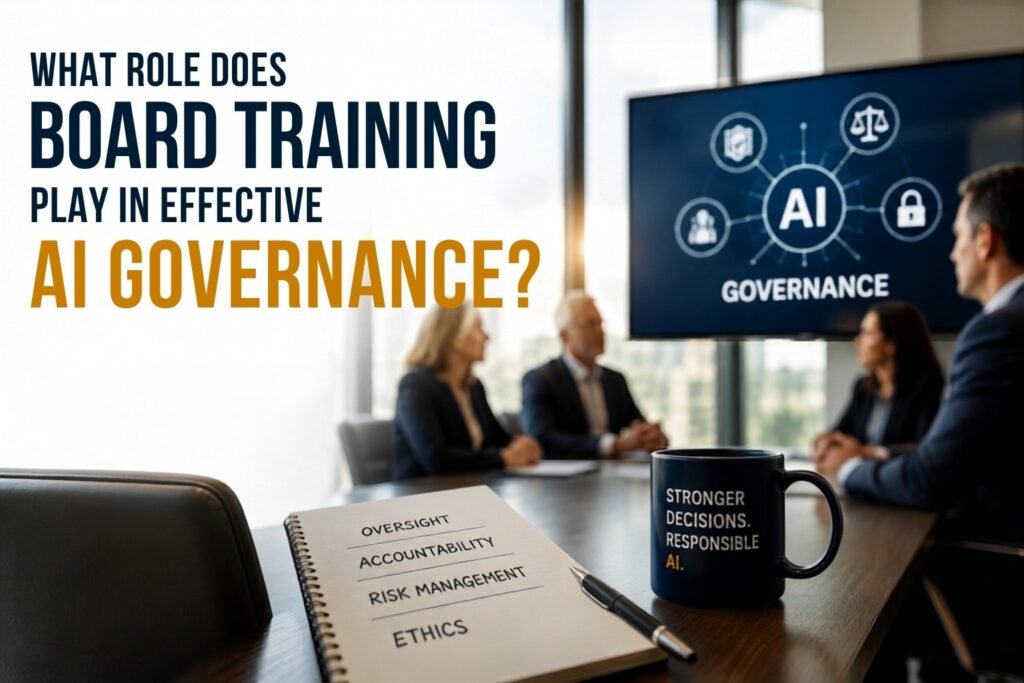
Artificial intelligence is rapidly becoming part of business strategy, operations, customer experiences, and decision-making. As organisations adopt AI, boards are increasingly expected to understand not only its potential benefits but also the risks associated with its use.
This raises an important question: What role does board training play in effective AI governance?
The answer goes beyond technical knowledge. Effective board training in AI governance helps directors understand how AI can affect business strategy, risk, compliance, ethics, cybersecurity, and organisational reputation. It enables boards to ask better questions and provide meaningful oversight without needing to become AI specialists.
Why Does AI Governance Need Board-Level Attention?
AI governance is not simply an IT responsibility. Decisions about AI can influence an organisation’s customers, employees, finances, regulatory obligations, and long-term reputation.
Boards therefore need visibility into questions such as:
- Where is AI being used across the organisation?
- What risks could AI create for the business?
- How are AI systems being monitored?
- Who is accountable when an AI system produces an incorrect or harmful outcome?
- Are AI practices aligned with regulatory and ethical expectations?
- How is sensitive business or customer data being protected?
Without appropriate board oversight, organisations may adopt AI faster than they can manage its associated risks.
How Can Board Training Improve AI Governance?
Effective training gives board members a structured understanding of AI and its governance implications. Rather than focusing only on how AI works technically, board training should connect AI to the organisation’s broader governance responsibilities.
A well-designed programme can help directors understand AI governance frameworks, accountability structures, risk management, data governance, cybersecurity, ethical considerations, and regulatory developments.
This knowledge allows boards to move from simply approving AI initiatives to actively challenging and overseeing them.
What Should Board Members Learn About AI Governance?
Board training should be practical and focused on decision-making. Key areas may include:
1. AI Strategy and Business Value
Boards should understand where AI can create value and how AI initiatives support the organisation’s strategic objectives.
2. AI Risk Management
AI can introduce risks involving inaccurate outputs, bias, privacy, cybersecurity, operational disruption, and reputational damage. Directors need to understand how these risks are identified, assessed, and managed.
3. Accountability and Oversight
One of the most important governance questions is accountability. Boards should understand who owns AI-related decisions, who monitors AI systems, and how issues are escalated.
4. Data and Privacy
AI depends heavily on data. Board members should understand whether data is being collected, stored, processed, and used responsibly and in accordance with applicable requirements.
5. Ethical and Responsible AI
Responsible AI requires organisations to consider transparency, fairness, human oversight, explainability, and the potential impact of AI decisions on stakeholders.
6. Regulatory and Compliance Expectations
The regulatory environment surrounding AI continues to develop. Boards need sufficient awareness to ensure that management is monitoring relevant requirements and preparing the organisation for regulatory change.
Can Board Training Help Directors Ask Better Questions?
Yes. One of the greatest benefits of board training in AI governance is that it enables directors to ask more meaningful questions.
Instead of asking only, “Are we using AI?”, boards can ask:
“What risks are associated with our AI use, and how are those risks being governed?”
Instead of asking, “How much value will this AI system create?”, they can ask:
“How are we measuring both the benefits and risks of this AI investment?”
These questions can encourage stronger accountability between the board, management, technology teams, risk functions, and other stakeholders.
Why Is AI Governance a Boardroom Issue Rather Than Just a Technology Issue?
AI can affect almost every part of an organisation. It can influence recruitment, financial decisions, customer service, marketing, cybersecurity, operations, and strategic planning.
As a result, AI governance needs to be connected with broader corporate governance.
The board’s responsibility is not necessarily to understand every algorithm or technical model. Its responsibility is to ensure that the organisation has appropriate structures, controls, accountability, and risk management around AI.
What Happens When Boards Are Not Prepared for AI Governance?
When boards lack sufficient AI awareness, important risks can be overlooked.
Organisations may struggle with unclear accountability, inadequate controls, poor data practices, unexpected regulatory exposure, or reputational consequences. There is also a risk that AI investments are approved without a clear understanding of their strategic value or risk profile.
Board training can help reduce this knowledge gap by giving directors the context they need to challenge assumptions and make informed decisions.
How Should Organisations Approach AI Governance Training for Boards?
Board training should not be treated as a one-time technology briefing. AI capabilities, risks, regulations, and business applications continue to evolve.
An effective programme should therefore be:
- Board-focused: Concentrate on governance, oversight, strategy, and risk rather than technical implementation.
- Practical: Use real-world business scenarios and board-level case discussions.
- Risk-oriented: Connect AI adoption with enterprise risk management and internal controls.
- Forward-looking: Help directors understand emerging AI developments and regulatory expectations.
- Relevant to the organisation: Address the specific AI applications, risks, and industry environment of the business.
What Is the Future of Board Training in AI Governance?
As AI becomes increasingly integrated into business decision-making, AI literacy at board level will become an important component of effective corporate governance.
Boards do not need to become AI engineers. They need to become sufficiently informed to understand the opportunities, challenge management effectively, recognise material risks, and ensure appropriate accountability.
Ultimately, board training in AI governance is about strengthening decision-making.
The organisations that benefit most from AI will not necessarily be those that adopt it the fastest. They will be those that understand how to balance innovation with responsibility, risk management, transparency, and strong governance.
Final Thought
AI governance should begin in the boardroom.
When directors have the right knowledge and confidence, they can provide stronger oversight, ask better questions, and help their organisations pursue AI innovation responsibly.
The real question is no longer whether boards need to understand AI. It is whether they are prepared to govern it effectively.

- ONLY 2 DAYS TO GO! Are you in? - September 30, 2026
- THE COUNTDOWN BEGINS – SESSION 1 OF OUR 12-PART WEBINAR SERIES! - September 30, 2026
- Raffles Education Institute Presents: Future-Ready Business Series 2026 - September 30, 2026