

Fraud Risk Management Training for Finance Teams and Senior Executives

Fraud rarely looks like a dramatic heist. More often, it arrives as a convincing invoice, a urgent email that appears to come from the CEO, or a small expense claim that nobody questions. Finance teams handle the money, and senior executives approve the decisions, so both groups are central to any organisation’s defence. Fraud risk management training gives them the knowledge and habits to spot warning signs early, respond correctly, and strengthen the controls that protect the business. Meta description: Learn how fraud risk management training helps finance teams and senior executives identify red flags, strengthen internal controls, and respond to fraud with confidence. What Is Fraud Risk Management? Fraud risk management is the structured process of identifying where fraud could occur, assessing how likely and how damaging it would be, and putting controls in place to prevent, detect, and respond to it. It goes beyond policy documents. A strong programme combines clear governance, practical controls, ongoing monitoring, and people who understand their role. Training sits at the heart of this process. Controls can be designed well and still fail if the people operating them do not recognise a suspicious transaction or feel unable to question a senior colleague’s request. Why Finance Teams and Senior Executives Need Dedicated Training Finance teams and senior leaders face different fraud risks, and both need tailored learning. Finance teams are on the front line of payments, payroll, procurement, and reporting. They are often the first to see an unusual vendor bank change, a duplicate invoice, or a journal entry posted outside normal hours. Without training, these signals can look like routine administration. Senior executives are targeted for a different reason. Their authority makes them valuable to fraudsters, who use impersonation, pressure, and urgency to bypass normal checks. Executives can also override controls, which is why their behaviour sets the tone for the whole organisation. Training that covers both groups builds a shared language, so that a finance officer feels confident asking a senior leader to verify a payment request, and the leader understands why that check matters. Common Fraud Risks to Cover in Training An effective programme should address the fraud types that organisations face most often. Key areas include: Using real, anonymised case studies from the organisation’s own sector makes these risks far easier to recognise. Core Elements of an Effective Training Programme A well-designed programme usually includes the following components. 1. Risk awareness and red flags. Participants learn to recognise patterns such as urgency, secrecy, unusual payment methods, and requests that bypass normal approval routes. 2. Internal controls in practice. Training should explain segregation of duties, dual authorisation for payments, vendor master data checks, and reconciliations, and show how each control prevents a specific type of fraud. 3. Ethics and the tone at the top. Leaders should discuss integrity openly, explain their own decision-making, and make clear that raising concerns is expected rather than disloyal. 4. Reporting and whistleblowing. Staff need to know how to report suspicions, who receives those reports, how confidentiality is protected, and what happens next. 5. Incident response. Participants should understand what to do the moment fraud is suspected: preserve evidence, avoid tipping off the suspect, escalate correctly, and involve legal or forensic support where needed. 6. Practical exercises. Simulations, such as a fake urgent payment request or a mock vendor onboarding review, help people apply what they have learned. Designing Training for Different Audiences One-size-fits-all training rarely changes behaviour. Consider tailoring content to each group. Audience Primary focus Suggested format Accounts payable and payroll Vendor changes, duplicate payments, approval controls Hands-on workshops and process walkthroughs Treasury and cash management Payment verification, bank detail changes, BEC Scenario drills and callback procedures Senior executives Impersonation, override risks, tone at the top Short briefings and tabletop exercises Board and audit committee Oversight, reporting, fraud risk appetite Governance sessions and key risk indicators Short, frequent sessions tend to work better than a single long course. Refreshers every few months keep threats current, especially as fraudsters adopt new tools such as AI-generated voice messages. Measuring the Impact of Training Training should be measured, not assumed to work. Useful indicators include: These measures help leaders show that the programme reduces real exposure, not only that employees attended a session. Building a Culture That Resists Fraud Training is most effective when it is reinforced by the wider organisation. Several practices help: Frequently Asked Questions Who should attend fraud risk management training? Finance teams, procurement staff, senior executives, and anyone who can approve payments, change vendor data, or influence financial reporting should attend. How often should training be delivered? An induction course for new joiners, followed by annual training and shorter refreshers throughout the year, works well for most organisations. Does training replace internal controls? No. Training makes controls work better. Strong controls are still essential, and training helps people use them correctly. Conclusion Fraud risk management training for finance teams and senior executives is one of the most cost-effective investments an organisation can make. It helps people recognise red flags, understand why controls matter, and act decisively when something looks wrong. When finance staff and leaders share the same knowledge and feel confident speaking up, the organisation becomes a much harder target for fraud. Start by identifying your highest-risk processes, tailor training to the people who run them, and measure the results over time.
Business Continuity Management (BCM) Consulting and Training in Malaysia: Build Organisational Resilience

A power outage, a cyber incident, a supplier failure, or a flood can stop a business within hours. The organisations that recover quickly are rarely the lucky ones. They are the ones that planned in advance. Business continuity management (BCM) is the discipline that helps an organisation keep its critical services running during disruption and recover in an orderly way. For Malaysian organisations, BCM is becoming a core part of governance. Boards, regulators, customers, and business partners increasingly expect evidence that a company can respond to disruption, not just a plan stored in a shared folder. What Business Continuity Management Really Means BCM is a structured process for identifying the threats to an organisation, understanding the impact of disruption, and building the capability to respond. It covers more than IT recovery. A complete BCM programme considers people, premises, suppliers, technology, information, and decision-making. A useful way to think about it is through three questions: Why Malaysian Organisations Need a Stronger Approach Many organisations have business continuity plans that were written for an audit and never tested. Common gaps include: Closing these gaps requires more than a template. It requires analysis, practice, and ownership across the business. The Core Components of an Effective BCM Programme A well-structured programme usually includes the following elements. 1. Governance and policy. Set a clear BCM policy, define roles and responsibilities, and agree on the level of risk the board is willing to accept. Senior sponsorship makes the difference between a live programme and a shelf document. 2. Business impact analysis (BIA). Identify critical activities, the maximum tolerable downtime for each, and the resources they depend on. The BIA is the foundation for every recovery decision. 3. Risk assessment. Evaluate the likelihood and impact of disruption scenarios, and link them to the BIA so that effort goes where the exposure is greatest. 4. Continuity strategies. Decide how critical activities will continue, such as alternate sites, remote working arrangements, backup suppliers, or manual workarounds. 5. Response and recovery plans. Document how the crisis team is activated, how staff and stakeholders are informed, and how operations are restored step by step. 6. Testing, training, and maintenance. Exercise the plans regularly, train the people who need to act, and update the programme after every test, incident, or major change. Aligning BCM with Recognised Standards Many Malaysian organisations use ISO 22301, the international standard for business continuity management systems, as a reference point. Aligning with a recognised framework helps organisations apply a consistent methodology, demonstrate maturity to stakeholders, and prepare for certification where it adds value. Standards are a guide, not a substitute for judgement. The aim is a programme that fits your organisation’s size, sector, and risk profile, and that can be proven through documented evidence and tested exercises. Organisations in regulated sectors should also check the expectations of their own supervisors, as continuity requirements can be specific to their industry. Why Training Matters as Much as the Plan A plan only works if people know what to do when it is activated. Training builds that capability across different levels of the organisation. Scenario-based exercises are especially valuable. A tabletop exercise that simulates a cyber incident or a supplier collapse often reveals gaps that no document review would find. A Practical Path to Building Resilience For organisations starting or strengthening their BCM programme, a phased approach works well. Phase 1: Assess the current state. Review existing plans, past incidents, and dependencies. Identify the most critical services and the largest gaps. Phase 2: Conduct the business impact analysis. Agree recovery priorities with business owners, not only with the IT or facilities team. Phase 3: Develop and integrate the plans. Build response and recovery plans, and connect them to the risk register, third-party risk management, and IT disaster recovery arrangements. Phase 4: Train and test. Deliver role-based training and run exercises at increasing levels of complexity. Phase 5: Review and report. Update plans after each exercise, track remediation actions, and report progress to the board or risk committee. Questions Every Board Should Ask Directors do not need to write plans, but they should test whether the programme is credible. Useful questions include: Building Resilience That Lasts Resilience is not a project with an end date. It is a habit built into how the organisation plans, buys, changes systems, and makes decisions. The most effective programmes keep BCM visible through regular reviews, simple KPIs such as test completion and remediation rates, and a clear link to strategy. Work With Dr Sivanesan on Business Continuity Dr S Sivanesan advises organisations in Singapore and Malaysia on governance, risk, and compliance. His work covers business continuity and resilience, board advisory, and executive training, helping leaders build programmes that are practical, tested, and well governed. Visit drssivanesan.com to explore BCM consulting and training and start building your organisation’s resilience.
Continuous Assurance and Risk-Based Internal Audit Services: Transform Audit from Reactive to Proactive
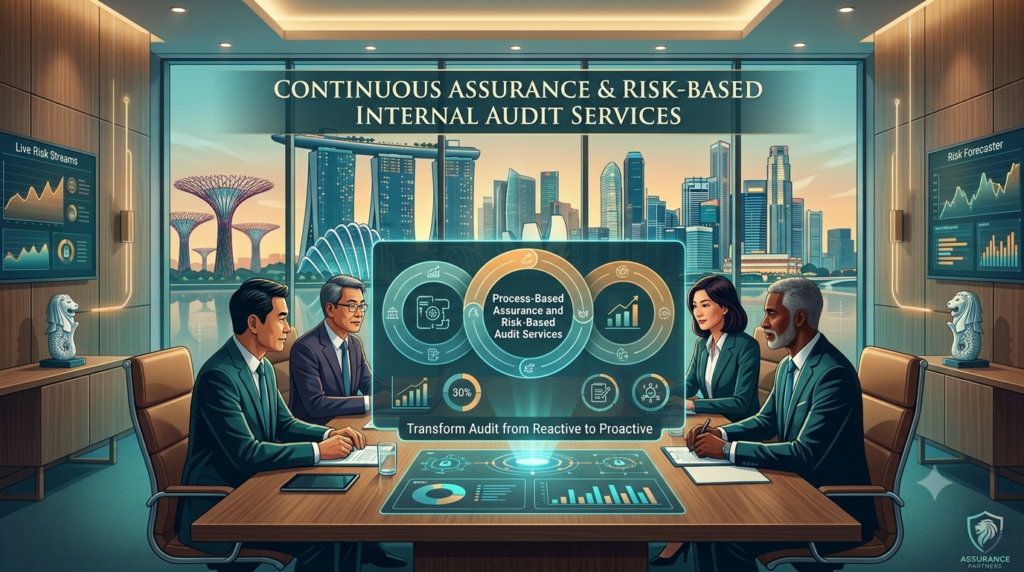
Traditional internal audit operates on a fixed cycle: annual audit plan, periodic testing, findings reported after testing completes. This reactive model discovers issues months after they occur, when damage is already done. In today’s complex, rapidly changing business environment, annual audits are insufficient. Organizations need continuous visibility into control effectiveness, early warning of emerging risks, and dynamic audit responses adapting to changing threat landscapes. Continuous assurance and risk-based internal audit services provide this modern approach—combining technology-enabled monitoring with strategic audit planning focused on highest-risk areas. This guide explains what modern audit looks like, why Singapore organizations need it, and how expert services from drssivanesan.com can transform your audit function from reactive compliance exercise into strategic governance tool. Why Traditional Audit Is No Longer Sufficient The limitations of traditional annual audit are becoming increasingly apparent. Traditional audit model: The problems: Issues discovered too late: By the time audit testing identifies a control weakness, the weakness has existed for months. If the weakness enabled fraud or compliance violations, damage is already done. Reactive to planned risks: Audit plans are developed based on previous year’s risks. New threats emerging mid-year aren’t addressed until next year’s audit cycle. By then, organizations have been exposed to new risks for extended periods. Low visibility between audits: Between audit cycles, management has minimal visibility into control effectiveness. Controls can degrade without detection. New risks can emerge unmonitored. Resource intensive: Annual audits require significant audit time conducting full testing of control samples. This is expensive and limits scope—auditors test samples, not populations. Compliance focused rather than strategic: Traditional audit emphasizes regulatory compliance over strategic insights. Auditors report findings; boards struggle to understand implications for business objectives. Slow to adapt: In rapidly changing environments (technology transformation, regulatory changes, business model shifts), annual audit cycles can’t keep pace. By the time audit addresses a risk area, the risk landscape has changed. Real consequence: A manufacturing company implements new ERP system in Q2. Traditional audit plan doesn’t include detailed ERP controls testing until Q4 (when testing occurs) or Q1 next year (when findings are reported). If ERP controls are weak, the organization has been exposed to risk for 6–12 months before discovering the issue. The Modern Audit Approach: Continuous Assurance and Risk-Based Methodology Modern audit transforms from fixed, reactive cycles to continuous, proactive monitoring—combining technology, data analytics, and strategic planning. Continuous assurance: Continuous assurance uses technology and data analytics to monitor controls continuously rather than through periodic testing. Instead of testing transaction samples once yearly, continuous assurance monitors all transactions in real-time, flagging anomalies and control violations immediately. Benefits: Risk-based audit: Risk-based audit prioritizes audit resources on highest-risk areas, aligning audit plan with enterprise risk landscape. Rather than testing all areas equally, resources concentrate where risk is greatest. Benefits: What Continuous Assurance and Risk-Based Audit Services Include Modern audit services from drssivanesan.com combine continuous assurance technology with risk-based methodology. Here’s what comprehensive services encompass: 1. Risk-Based Audit Planning Strategic audit planning aligned with enterprise risks: Rather than predetermined annual audit schedules, risk-based planning dynamically aligns audit resources with organizational risk landscape. Process: Outcome: Real example: A financial services organization identifies cyber risk and operational resilience as top-10 risks. Risk-based audit planning allocates 40% of audit resources to these areas, with quarterly testing throughout the year rather than single annual audit. Emerging cyber threats are addressed immediately; operational resilience is tested before crises occur. 2. Continuous Assurance Technology and Monitoring Real-time control monitoring using advanced technology: Continuous assurance implements monitoring systems enabling real-time oversight of critical controls. Technology approaches: Implementation: Outcomes: Real example: A retail organization implements continuous monitoring of cash handling controls. Instead of annual audit testing transaction samples, the system monitors every transaction in real-time, flagging discrepancies immediately. A cash handling control weakness is detected in Week 2, allowing immediate corrective action rather than discovery months later during annual audit. 3. Data Analytics and Forensic Capabilities Advanced analytics revealing patterns invisible in traditional testing: Data analytics apply statistical and investigative techniques to transaction data, revealing control weaknesses and anomalies. Analytics capabilities: Applications: Real example: Analytics on procurement data reveal that one vendor receives consistently higher prices for identical items than other vendors. Forensic analysis discovers unauthorized price negotiations, enabling immediate corrective action and potential recovery of overcharges. 4. Control Environment Assessment Evaluating the organizational culture and systems supporting controls: Beyond testing individual controls, modern audit assesses the control environment—the culture, governance structure, and systems enabling effective controls organization-wide. Assessment components: Outcomes: 5. Technology and System Controls Audit Specialized audit of technology systems, integrations, and IT controls: As technology becomes central to business operations, technology controls require specialized audit expertise. Areas covered: Real example: Technology controls audit of an ERP system discovers that access controls allow users to approve their own transactions—a critical control breakdown. The issue is identified through continuous monitoring before fraud occurs, enabling immediate remediation. 6. Regulatory Compliance Audit Specialized audit of regulatory compliance obligations: For regulated organizations (financial services, healthcare, energy), regulatory compliance audit ensures obligations are being met. Coverage: Approach: Real example: PDPA compliance audit of a healthcare organization discovers that personal data is not adequately encrypted and access controls are insufficient. Audit identifies this gap before data breach occurs, enabling remediation and reducing breach risk. 7. Risk Assessment and Audit Scoping Strategic assessment defining audit scope aligned with risks: At engagement start, comprehensive risk assessment determines what should be audited and how deeply. Process: Outcome: 8. Audit Reporting and Board Communication Strategic reporting providing board-level insights: Modern audit reporting goes beyond listing findings to providing strategic insights enabling board governance. Reporting elements: Outcomes: 9. Fraud Detection and Prevention Specialized audit addressing fraud risk: Modern audit includes fraud detection and prevention capabilities beyond traditional control testing. Fraud audit approach: Real example: Fraud audit using data analytics discovers that a purchasing manager consistently approves purchases from a vendor owned by a relative, at prices significantly above market rates. Forensic investigation reveals ongoing fraud, enabling recovery and prosecution. 10. Internal Audit Function Enhancement Strengthening the internal audit function itself: Beyond conducting audits, services
SGX Climate Reporting, Bursa Malaysia Sustainability Reporting, and Scope 1, 2 and 3 Explained for Boards

Climate and sustainability disclosure has moved from voluntary good practice to a core board responsibility in Singapore and Malaysia. Investors, lenders, and regulators now expect companies to report emissions, climate risks, and governance over those risks with the same discipline they apply to financial statements. For directors, the challenge is not only to understand the rules but to ask the right questions before a report is signed off. This article covers the climate reporting requirements of the Singapore Exchange (SGX), the sustainability reporting framework of Bursa Malaysia, and the Scope 1, 2 and 3 emissions categories that sit at the centre of both regimes. It closes with a practical checklist for boards and a note on the governance and ESG conversations that matter most in the region. Why Boards Need to Understand These Rules Sustainability reporting used to sit with a small team of communications or ESG staff. That is no longer realistic. A sustainability report is a public document that carries legal and reputational weight, and the board is responsible for overseeing the risks and opportunities it describes. When a company reports that its emissions have fallen, or that climate risk has been assessed, directors need to be able to explain how those conclusions were reached. Three questions help frame the discussion at board level: SGX Climate Reporting Requirements The SGX-ST requires each listed issuer to publish an annual sustainability report, and this requirement is designed to add transparency and encourage efficiency and innovation. Under the SGX rulebook, climate-related disclosures sit within the sustainability report and must follow the requirements set out in Practice Note 7.6. The Core Principles For climate-related disclosures, SGX expects issuers to report based on the recommendations of the Task Force on Climate-related Financial Disclosures (TCFD), and to follow the chosen framework from year to year. The TCFD structure is built around four areas: Who Must Report Emissions All listed issuers must disclose Scope 1 and Scope 2 greenhouse gas (GHG) emissions. STI constituents must also provide other climate-related disclosures. Linklaters notes that the mandatory climate reporting regime applies to all issuers listed on the Singapore Exchange, so the regime is broad even though some obligations are phased or tiered. Because requirements can be phased, boards should not rely on a summary from an earlier year. Check the current text of Practice Note 7.6 and the SGX sustainability reporting guidance each financial year, and confirm your company’s obligations with your external auditors or sustainability advisers. What a Strong SGX Climate Disclosure Looks Like A good climate disclosure does more than list numbers. It should: Bursa Malaysia Sustainability Reporting Bursa Malaysia has moved its sustainability reporting onto the International Sustainability Standards Board (ISSB) framework. Its amended listing requirements, effective from December 2024, align with the National Sustainability Reporting Framework (NSRF), and the sustainability statement must follow the IFRS Sustainability Disclosure Standards. The Structure of the Requirement The Malaysian approach is built on two IFRS standards: In-scope companies must prepare a sustainability statement under IFRS S1 and IFRS S2, and publish it in the annual report at the same time as the financial statements. The rollout is phased. Bursa Malaysia’s media release indicates that the first group of Main Market companies applies the IFRS Sustainability Disclosure Standards for annual reporting periods starting on or after 1 January 2025, followed by the remaining Main Market listed companies on a later timetable. The IFRS Malaysia jurisdictional profile also refers to applicability dates for IFRS S1 and IFRS S2 that extend into later years. Because the timelines differ by company category, the practical step for every board is to confirm three things: which group your company falls into, the first financial year in which the standards apply, and whether any transitional relief is available for particular disclosures. Practical Implications for Malaysian Boards The move to IFRS S1 and S2 changes the nature of the report. Disclosure is no longer a narrative exercise. Boards should expect: Scope 1, 2 and 3 Explained for Boards Greenhouse gas emissions are grouped into three scopes. These categories are used in both SGX and Bursa reporting, so every director should be comfortable with what they mean. Scope 1: Direct Emissions Scope 1 covers emissions released directly from sources that the company owns or controls. Examples include fuel burned in company boilers, vehicles, and generators, along with emissions from processes such as manufacturing or refrigerant leaks. For a board, Scope 1 is the most within the company’s direct control. Reductions often come from equipment upgrades, fuel switching, fleet management, or process changes. Scope 2: Indirect Emissions from Purchased Energy Scope 2 covers emissions from the generation of electricity, heat, steam, or cooling that the company purchases and consumes. The emissions occur at the power station, but they are counted in the company’s inventory because the company creates demand for that energy. Scope 2 reductions can come from energy efficiency, on-site renewable generation, and renewable energy procurement. Boards should ask whether the company reports Scope 2 using a location-based method, a market-based method, or both, and why. Scope 3: Value Chain Emissions Scope 3 covers all other indirect emissions across the value chain, both upstream and downstream. These can include purchased goods and services, business travel, employee commuting, transport and distribution, use of sold products, and end-of-life treatment. Scope 3 is often the largest category for service businesses and many manufacturers, and it is also the hardest to measure. Data comes from suppliers, customers, and third parties, and the quality of that data varies. Boards should expect management to explain: A Simple Way to Remember the Scopes Questions Every Board Should Ask Directors do not need to calculate emissions, but they do need to test whether the process is sound. These questions can guide a board discussion before approving a sustainability report. Building a Reporting Process That Works Strong disclosure depends on a repeatable process rather than a last-minute effort. A practical approach has five stages. Stage 1: Map your obligations. Confirm your listing venue, your category
GRC Consulting Services for Singapore Businesses: Build Integrated Governance, Risk, and Compliance

Singapore businesses face an increasingly complex regulatory landscape. Corporate Governance Code requirements, MAS expectations, PDPA obligations, environmental compliance, ESG reporting, and industry-specific regulations create overlapping demands. Many organizations manage these separately—governance in one silo, risk management in another, compliance functions scattered across departments. This fragmented approach is inefficient, expensive, and creates blind spots where gaps fall through. GRC (Governance, Risk, and Compliance) consulting provides an integrated framework addressing all three domains in a coordinated, efficient approach. This guide explains what modern GRC means, why Singapore businesses need it, and how expert GRC consulting from drssivanesan.com can transform your organization’s governance maturity. Why Singapore Businesses Need Integrated GRC Consulting The regulatory landscape for Singapore businesses has become exponentially more complex. Regulatory requirements have multiplied: The problem with siloed management: Most organizations manage these separately: The gaps this creates: The consequence: The solution: GRC (Governance, Risk, and Compliance) consulting provides an integrated framework connecting all three domains. Instead of separate functions operating independently, GRC ensures: What Modern GRC Consulting Encompasses GRC isn’t a single function—it’s an integrated approach addressing three interconnected domains: 1. Governance (The G in GRC) Governance sets the framework for how organizations are led and controlled. GRC consulting addresses: Why it matters: Strong governance provides the foundation for effective risk management and compliance. Without clear governance, risk management becomes ad-hoc and compliance becomes box-checking rather than embedded in operations. 2. Risk Management (The R in GRC) Risk management identifies and controls threats to organizational objectives. GRC consulting addresses: Why it matters: Comprehensive risk management prevents crises, informs strategic decisions, and guides resource allocation toward highest-risk areas. Without integrated risk management, organizations react to problems rather than preventing them. 3. Compliance (The C in GRC) Compliance ensures the organization meets regulatory obligations and follows internal policies. GRC consulting addresses: Why it matters: Regulatory compliance protects the organization from fines, reputational damage, and legal liability. Integrated compliance ensures obligations are met efficiently rather than through scattered, reactive efforts. How GRC Consulting Integrates These Three Domains The power of GRC consulting lies in connecting governance, risk, and compliance into an integrated framework. Real example: Data Protection (PDPA Compliance) Siloed approach: These functions operate independently, often duplicating effort or creating gaps. Integrated GRC approach: Result: Clear governance framework, risk-informed compliance controls, single integrated monitoring system, board visibility into data protection risk and compliance status. What GRC Consulting from drssivanesan.com Addresses Comprehensive GRC consulting covers the full governance, risk, and compliance landscape. Here’s what modern programs include: 1. Current State Assessment and Maturity Evaluation Understanding where you are: GRC consulting begins with thorough assessment: Deliverables: 2. Governance Framework Development Building strong governance foundations: Consulting addresses: Deliverables: 3. Enterprise Risk Management Framework Building systematic risk management: Consulting establishes: Deliverables: 4. Compliance Program Design and Implementation Establishing comprehensive compliance management: Consulting develops: Deliverables: 5. Integration of Governance, Risk, and Compliance Connecting the three domains: This is where GRC consulting delivers unique value. Rather than three separate frameworks, consulting creates integration: Result: More efficient operations, fewer blind spots, clearer board visibility, better resource allocation. 6. MAS and SGX Compliance for Financial Services and Listed Companies Regulatory-specific guidance: For regulated entities, GRC consulting addresses: Consulting ensures your GRC framework addresses these specific regulatory expectations. 7. Technology and Cyber Risk Governance Emerging risk domain requiring board oversight: GRC consulting addresses: This integrates technology risk into overall governance, risk, and compliance framework. 8. Environmental, Social, and Governance (ESG) Framework Integrating sustainability into GRC: Consulting helps organizations address: 9. Internal Audit and Control Testing Validating that controls work: GRC consulting often includes: 10. GRC Technology and Tools Implementing systems to manage GRC: Consulting addresses: Why Expert GRC Consulting from drssivanesan.com Makes a Difference drssivanesan.com brings specialized expertise to GRC consulting: Board and C-suite experience: Consultants with board-level governance and executive experience understand how governance, risk, and compliance decisions are made and what information boards need. Singapore and ASEAN context: Deep understanding of Singapore’s regulatory landscape—Corporate Governance Code, MAS expectations, PDPA, SGX requirements, BNM guidelines for Malaysian operations. Consulting addresses regional context, not generic global frameworks. Integrated GRC approach: Rather than separate governance, risk, and compliance engagements, drssivanesan.com provides truly integrated consulting where the three domains inform each other. Practical implementation focus: Consulting doesn’t just identify gaps; it provides actionable roadmaps, tools, and templates you can implement immediately. Sector expertise: Specialized knowledge of financial services, healthcare, energy, real estate, and other regulated sectors enables sector-specific guidance. Ongoing partnership: Beyond initial consulting, drssivanesan.com provides ongoing advisory support helping you embed and sustain GRC improvements. Types of GRC Consulting Engagements Full GRC Program Development: Comprehensive assessment and framework development covering governance, risk, and compliance. Typically 3–6 months for established organizations. Governance Enhancement: Focused engagement improving board governance, committee effectiveness, and governance policies. 6–12 weeks. Enterprise Risk Management: Establishing systematic enterprise risk management framework. 3–4 months. Compliance Program: Developing compliance framework addressing specific regulations. 2–3 months depending on regulatory complexity. GRC Technology Implementation: Selecting and implementing GRC software platforms. 2–6 months depending on complexity. Regulatory Preparation: Preparing for regulatory examination or audit. 4–8 weeks focused preparation. Crisis GRC Response: Rapid assessment and remediation when compliance or governance issues emerge. Flexible timeline based on urgency. How to Get Started with GRC Consulting Step 1: Assess Your Current State What’s your governance maturity? Do you have systematic risk management? Are you meeting compliance obligations? Where are the biggest gaps? Step 2: Identify Your Priorities Is this about governance improvement, risk management implementation, compliance enhancement, or integrated GRC development? What regulatory drivers exist? What’s your timeline? Step 3: Connect with drssivanesan.com Contact the GRC consulting team to discuss your current state, priorities, and desired outcomes. Step 4: Develop a Consulting Roadmap Work collaboratively to design a consulting engagement addressing your specific needs and timeline. Step 5: Implement Recommendations Execute the consulting recommendations, building governance, risk, and compliance capability within your organization. Step 6: Sustain and Improve Embed GRC improvements into ongoing operations, measure progress, and continuously refine your framework. FAQ Q: What’s the difference between GRC consulting and separate governance,
HRD Corp Claimable Courses for Risk Management and Governance in Malaysia

Risk and governance have moved from the boardroom to every department. Regulators, auditors, and clients now expect staff at many levels to understand how risks are identified, how decisions are documented, and how organisations stay accountable. For Malaysian employers, the HRD Corp scheme offers a practical way to build these skills. Approved training can be claimed through the scheme, so the right course can meet a genuine capability gap while staying within your training plan. This guide explains what HRD Corp claimable training means, which risk management and governance courses are available, how to choose the right programme, and how to prepare a claim. It is written for HR managers, training coordinators, risk and compliance teams, and business owners who want to plan their training properly. What “HRD Corp Claimable” Means HRD Corp is Malaysia’s national human resource development council. It administers a levy-based training scheme that allows eligible employers to claim the cost of approved training from their levy contributions. The HRD Corp portal explains that employers can claim training costs for HRD Corp-approved courses, and that this creates steady demand for Registered Training Providers. The key word is approved. A course is claimable only when it meets the scheme’s requirements and is delivered by a provider registered with HRD Corp. A course that looks professional or is widely recommended is not automatically claimable. Before you enrol anyone, confirm three things: Many providers now state clearly on their marketing material that a course is HRD Corp claimable. Treat that as a starting point, not a final check. Confirm the approval on the official HRD Corp portal before you commit. Why Risk Management Training Matters Risk management is no longer the job of one specialist. Operations managers decide which suppliers to use, finance teams review how payments are controlled, and project leads decide when a delay becomes a serious threat. Staff who understand the basic structure of risk, from identifying a hazard to deciding how to respond, make better decisions in their daily work. An introductory programme such as the Fundamentals of Risk Management (FoRM) gives a shared language to people across an organisation. Industry bodies have run this course in Malaysia as an HRD claimable programme, and some describe it as a practical introduction to enterprise risk management. Participants learn how to: For smaller organisations, a single introductory course can help a whole team start using the same risk register and vocabulary. For larger firms, it can form the base layer before more specialist programmes. Why Governance Training Matters Governance covers how an organisation is directed and controlled. It includes board responsibilities, ethical conduct, transparency, internal controls, and the way the organisation handles its obligations to shareholders, staff, and the wider community. Sustainability has become part of this conversation, as many companies now report on environmental and social performance alongside financial results. Corporate governance and sustainability programmes are offered in Malaysia as HRD Corp claimable training. These courses suit: Governance training is especially useful when an organisation is preparing for growth, a funding round, a listing, or a change in regulation. It gives leaders the knowledge to ask the right questions and to document decisions properly. Choosing the Right Course With several claimable options available, the best choice depends on your organisation’s needs, not on the course title alone. Use these questions to guide your decision. 1. What problem are you solving? If staff struggle to describe risks consistently, an introductory risk course is a good fit. If the board needs to strengthen oversight, a governance programme may be more useful. If your business faces both, plan a sequence. 2. Who needs the training? Match the level to the audience. Front-line supervisors need practical tools. Senior managers need frameworks and decision-making skills. Board members need governance knowledge that links to their legal duties. 3. How will the learning be applied? Ask whether participants can use what they learn within a month. Good training ends with a clear action, such as updating a risk register, reviewing a committee charter, or revising an internal control. 4. Does the provider have relevant experience? Look for trainers with industry background, clear course outlines, and examples drawn from Malaysian regulation and business practice. Ask for a sample agenda before you enrol. 5. Is the course approved for your situation? Confirm the approval status and the requirements for your organisation, including any conditions that apply to employer registration or training plans. A Practical Training Plan A structured plan makes claimable training more valuable and easier to justify internally. Consider the following approach. Step 1: Run a training needs analysis. Review recent audit findings, incident reports, staff feedback, and changes in regulation. Identify two or three real gaps, such as weak risk reporting or unclear board minutes. Step 2: Map the gaps to courses. Match each gap to a claimable course. A simple table can show the gap, the target audience, the course, and the expected outcome. Step 3: Sequence the learning. Start with an introductory risk course for the wider team, then add governance training for committee members and senior leaders. Spread the sessions across the year so that the business can absorb the changes. Step 4: Plan the follow-up. Within two to four weeks of each course, schedule a short review meeting. Ask participants to apply one tool or process from the training and report back. Step 5: Measure the results. Track simple indicators, such as the number of risks logged, the time taken to escalate issues, the quality of board papers, or the number of audit points closed. How to Prepare an HRD Corp Claim Claim procedures can change, so always check the current requirements on the official HRD Corp portal. In general, employers should prepare the following: Keep your records organised from the start. Many claim problems happen because documents are incomplete, not because the training itself was ineligible. Assign one person to manage training records and check them before each session. Common Mistakes to Avoid Several errors can weaken an otherwise good training programme: Building Long-Term Capability Risk and governance skills
Cyber Risk Management Training for Board Directors: Build Board Competence in Digital Threats

Cyber risks have moved from IT department concerns to board-level governance imperatives. Regulators, investors, and stakeholders expect boards to understand cyber threats, oversee controls, and respond effectively to incidents. Yet many directors lack the cybersecurity expertise to fulfill these responsibilities. This guide explains what modern cyber risk governance means, why board directors need specialized training, what comprehensive programs cover, and how to build your board’s cyber competence—with expert guidance from drssivanesan.com. Why Board Directors Need Cyber Risk Management Training The digital landscape has fundamentally transformed enterprise risk. Cyber attacks are no longer hypothetical concerns—they’re regular occurrences affecting organizations across all sectors. Ransomware paralyzes operations. Data breaches expose customer information and trigger regulatory fines. Supply chain attacks compromise critical systems. Insider threats damage from within. Nation-state actors target infrastructure. But the cyber risk problem extends beyond IT incidents. A cyber attack creates cascading consequences: Boards face new expectations: MAS (Monetary Authority of Singapore) requires financial institutions to have board-level cyber governance. SGX (Singapore Exchange) expects listed companies to disclose cyber risk management practices. PDPA (Personal Data Protection Act) holds boards accountable for data protection failures. Insurance companies increasingly scrutinize cyber governance before issuing coverage. Institutional investors ask about cyber risk management during shareholder engagement. The disconnect: Most directors received their governance training years ago, before cyber risk became a board-level imperative. They understand financial controls, audit, and traditional risk management. But cyber risk is different—it’s technically complex, evolves rapidly, and intersects with strategy, operations, compliance, and human behavior. The consequence: Boards make uninformed decisions about cyber investments. They ask insufficient questions about controls. They’re surprised by incidents that should have been anticipated. They struggle to respond effectively when breaches occur. The solution: Specialized cyber risk management training designed for board directors—not IT staff, but decision-makers who need to understand cyber risk governance at a strategic level. What Modern Cyber Risk Governance Means Cyber risk governance differs fundamentally from traditional risk management. Traditional governance focuses on preventing known risks through established controls. Cyber governance must address unknown, evolving threats in a constantly changing threat landscape. Traditional risk frameworks assume relatively stable environments. Cyber risk operates in dynamic conditions where today’s security measures become tomorrow’s vulnerabilities. Modern cyber risk governance encompasses: Risk identification and assessment: Understanding what cyber threats could affect your organization. Not just technical vulnerabilities, but business-critical systems, sensitive data repositories, supply chain dependencies, and third-party risks. Assessing likelihood and potential impact of different threat scenarios. Control design and implementation: Building defenses appropriate to the threats and risk appetite. This includes technical controls (firewalls, encryption, intrusion detection), process controls (access management, incident response, employee training), and governance controls (policies, oversight, accountability). Threat monitoring and detection: Continuous monitoring for suspicious activity. This includes network monitoring, endpoint detection, user behavior analytics, and threat intelligence. The goal is detecting incidents quickly before damage escalates. Incident response and recovery: When attacks occur (and they will), responding effectively to contain damage, recover systems, communicate with stakeholders, and prevent recurrence. This includes crisis management, forensics, regulatory notification, and public communication. Third-party and supply chain risk: Managing risks from vendors, partners, and suppliers who have access to your systems or data. This includes vendor assessment, contract requirements, monitoring, and incident response coordination. Board oversight and accountability: Ensuring the board understands cyber risks, approves risk appetite and strategy, monitors key metrics, and responds to escalated issues. This includes regular reporting, committee structures, and executive accountability. This comprehensive approach recognizes that cyber risk is an enterprise-wide challenge requiring board-level governance and executive accountability. What Cyber Risk Management Training for Directors Covers Comprehensive training for board directors combines technical understanding with governance frameworks. Here’s what modern programs include: 1. Cyber Risk Fundamentals for Non-Technical Directors The challenge: Explaining cyber concepts to directors who don’t speak “IT language.” Directors don’t need to understand how encryption algorithms work, but they need to understand: Training translates cyber concepts into business language, enabling directors to understand cyber risk without becoming cyber experts. Real example: A ransomware attack encrypts company files. Training teaches directors: This understanding enables directors to ask: “Are we patching promptly? Do we have offline backups? Are employees trained on phishing?” 2. Cyber Risk Landscape and Threat Assessment Understanding your specific threats: Not all organizations face identical cyber risks. A bank faces different threats than a manufacturing company. A healthcare provider faces different risks than a retailer. Training helps directors identify threats relevant to their organization. Directors learn to assess: This structured approach moves beyond fear-based discussions to systematic threat understanding. Real scenario: A manufacturing company identifies its threats: The board can then focus investments on these specific risks rather than generic cyber spending. 3. Cyber Governance Frameworks and Standards The governance structures enabling effective cyber risk management: MAS expects financial institutions to have cyber risk governance frameworks. SGX recommends governance practices for listed companies. ISO 27001 provides cybersecurity management standards. NIST Cybersecurity Framework offers a structured approach. Directors learn: This framework knowledge prevents ad-hoc cyber management and builds systematic governance. 4. Board Oversight of Cyber Risk What boards must do to oversee cyber risk effectively: Effective board oversight requires: Training teaches directors to translate governance concepts into board meeting actions: What questions to ask? What metrics to monitor? When to escalate? Board-level cyber questions: These questions signal board engagement and drive management accountability. 5. Cyber Risk Assessment and Prioritization Identifying and prioritizing the most significant cyber risks: Organizations face numerous potential cyber threats. Without prioritization, resources spread too thin. Directors learn systematic risk assessment: This prevents both complacency (ignoring real risks) and panic (treating every risk as critical). Example heat map: The board focuses management on the high-priority risks while ensuring lower-priority risks are managed appropriately. 6. Cyber Controls and Incident Response Understanding what controls should be in place and how to respond when they fail: Controls fall into categories: Directors learn what controls should exist, how to verify they’re operating, and what to expect from incident response. Incident response components: Understanding this flow helps directors ask appropriate questions and set realistic expectations. 7. Cyber Incident Management and Board Communication What happens when a cyber attack occurs: Directors need clear protocols for cyber
Enterprise Risk Management (ERM) Consulting and Training in Singapore: Build Resilience, Reduce Crisis Risk

Enterprise Risk Management (ERM) isn’t just about compliance or risk reporting. It’s about building organizational resilience—identifying and controlling risks before they become crises. This guide explains what modern ERM is, why Singapore companies need it, what consulting and training covers, and how to choose the right partner to build ERM maturity in your organization. The Business Case: Why ERM Matters Now The reality of modern business risk: Singapore companies face a complex risk landscape: The problem: Most companies manage risks in silos: The gaps: The solution: Enterprise Risk Management (ERM) provides a framework to: The outcome: Companies with mature ERM: What Is Enterprise Risk Management (ERM)? The definition: Enterprise Risk Management is a structured, board-approved process for identifying, assessing, controlling, monitoring, and reporting on risks across the entire organization—aligned with the company’s strategy and risk appetite. Key elements: Why it’s different from traditional risk management: Traditional Risk Management Enterprise Risk Management (ERM) Manages risks in silos (finance, IT, ops) Integrated view across the organization Reactive (responds to problems) Proactive (identifies risks before crisis) Focuses on compliance and reporting Focuses on strategy, performance, and resilience Reports to individual committees Reports to board and executives Doesn’t align with strategy Aligned with business strategy and risk appetite Real example: A Singapore bank’s traditional approach: A crypto exchange hacks the bank’s systems. Under traditional silos: With ERM: Why Singapore Companies Need ERM Now Five drivers: 1. Regulatory Expectations Have Increased MAS (Monetary Authority of Singapore): SGX (Singapore Exchange): PDPA (Personal Data Protection Act): Sector-specific regulators: 2. Business Complexity Has Grown 3. Crises Are More Costly and Public 4. Investors and Partners Scrutinize Risk Management 5. Competitive Advantage Through Resilience What Enterprise Risk Management Consulting Covers When you engage an ERM consultant, here’s what you’re getting: 1. Risk Maturity Assessment What it covers: Deliverables: Why it matters: You can’t improve what you don’t understand. A maturity assessment gives you a clear picture of current state and direction for improvement. 2. Risk Appetite and Tolerance Setting What it covers: Deliverables: Why it matters: Without clear risk appetite, executives don’t know how much risk to take. They either take too much (leading to crises) or too little (missing opportunities). A defined risk appetite aligns decision-making. Real example: A manufacturing company’s board defines risk appetite: This guides executive decisions. When a salesperson wants to do business with a new supplier, they check against risk appetite. If the supplier can’t meet standards, it’s an automatic no. 3. Enterprise-Wide Risk Identification What it covers: Methodology: Deliverables: Why it matters: Most companies don’t know all the risks they face. They discover them when crises happen. A systematic risk identification ensures the board knows what could hurt the company. Real example: A Singapore tech company’s risk identification workshop uncovers: Before this workshop, executives knew about some of these. The workshop ensures the board sees the complete picture. 4. Risk Assessment and Prioritization What it covers: Deliverables: Why it matters: Not all risks are equally important. Assessment and prioritization focus the organization on the most significant risks and how to control them. Real example: A manufacturing company’s risk heat map shows: The company focuses resources on top-left and top-right risks. Bottom-left is monitored but not heavily invested. Bottom-right is monitored but minimal effort. 5. Risk Control and Mitigation Strategy What it covers: Control framework: Deliverables: Why it matters: Identifying risks is step one. Controlling them is the real work. A clear control strategy ensures you’re spending capital on the highest-impact mitigations. Real example: A Singapore bank’s cyber risk control strategy: When a cyber attack occurs, these controls minimize impact and accelerate response. 6. Risk Governance and Organization What it covers: Governance model options: Deliverables: Why it matters: If no one is accountable for risk, risks aren’t managed. Clear governance ensures risk oversight is consistent and connected to the board. 7. Risk Monitoring and Reporting What it covers: KRIs (Key Risk Indicators): Reporting framework: Deliverables: Why it matters: Risks change. What’s high-risk today might be low-risk tomorrow (or vice versa). Continuous monitoring and reporting keep the board and management current and enable early response. 8. Crisis Management and Business Continuity What it covers: Deliverables: Why it matters: Even with good controls, things go wrong. A crisis management plan ensures you respond quickly and minimize damage. 9. Risk Culture and Change Management What it covers: Culture elements: Deliverables: Why it matters: ERM frameworks don’t work without a supporting culture. If executives see risk management as a checkbox, it fails when real crises hit. What Enterprise Risk Management Training Covers ERM training complements consulting—it builds organizational capability so risk management is sustained over time. 1. Executive Leadership on ERM (1–2 days) Who it’s for: What it covers: Outcome: 2. Board-Level Risk Governance Training (2–3 days) Who it’s for: What it covers: Outcome: 3. Risk Management Program (3–5 days) Who it’s for: What it covers: Outcome: 4. Specialized Risk Tracks Examples: Cyber and Technology Risk Management (2–3 days) Operational Risk Management (2–3 days) Financial Risk Management (2–3 days) Compliance and Regulatory Risk (1–2 days) Climate and ESG Risk (1–2 days) The ERM Consulting and Training Process How a typical ERM engagement unfolds: Phase 1: Discovery and Assessment (Weeks 1–4) Phase 2: Strategic Planning (Weeks 5–8) Phase 3: Risk Identification and Assessment (Weeks 9–16) Phase 4: Control Design and Implementation (Weeks 17–28) Phase 5: Training and Rollout (Weeks 29–36) Phase 6: Embedding and Sustaining (Weeks 37–52) How to Choose an ERM Consulting and Training Partner What to look for: ✓ Deep Singapore and ASEAN Experience ✓ Proven ERM Frameworks ✓ C-Suite and Board Experience ✓ Practical Implementation Focus ✓ Blended Approach: Consulting + Training ✓ Sector Expertise (If Relevant) ✓ Flexibility and Customization ERM Implementation Roadmap: 12-Month Plan What a typical 12-month ERM implementation looks like: Months 1–2: Foundation Months 3–4: Strategy and Governance Months 5–7: Risk Identification and Assessment Months 8–9: Control Design and Monitoring Months 10–11: Training and Communication Month 12: Embedding and Review Year 2+: Sustaining and Improving The ROI: What You’ll Get From ERM Consulting and Training Direct benefits: Indirect benefits: Quantifiable outcomes: ERM Consulting and Training
Board Questions to Ask Management About AI Risk

1. What’s Our Definition of “High-Risk AI,” and Where Are We Using It? Most boards discover their AI exposure by accident. Management deploys models in customer-facing systems, hiring, credit decisions, or supply-chain optimization without a formal definition of what constitutes high-risk use. What to listen for: Red flag: “We don’t really have high-risk AI” or “Our data scientists handle that.” If management can’t articulate it, they haven’t governed it. Why this matters: Regulators (MAS, SGX, PIC) are moving toward AI governance requirements. Boards that can’t name their high-risk AI can’t demonstrate due diligence. Liability and reputational risk follow. 2. How Do We Test AI Models for Bias, and Who’s Accountable? AI bias isn’t a technical problem it’s a governance problem. Biased hiring models, discriminatory pricing, or unfair lending decisions create legal and regulatory exposure. What to listen for: Red flag: “Our data scientists test it” or “We use a third-party tool.” Without clear ownership and a defined process, testing doesn’t happen consistently. Why this matters: Regulators in Singapore, Malaysia, and globally are enforcing AI fairness. Litigation over algorithmic discrimination is rising. A board that can’t describe bias controls can’t defend the decision to deploy. 3. If an AI Decision Goes Wrong, How Do We Explain It? Explainability is both a regulatory requirement and a business risk. Imagine a customer lawsuit over a credit decision, a hiring discrimination claim, or a regulatory investigation. Can management explain why the AI said no? What to listen for: Red flag: “It’s a black box, but it works.” Or “We’re still figuring that out.” Why this matters: Upcoming AI Act-style regulations (Singapore’s AI governance framework, PDPA amendments) will require explainability for high-impact decisions. Courts and regulators already expect it. A board without explainability controls owns the reputational and legal fallout. 4. What’s Our Process for Retiring or Updating AI Models? Most conversations focus on deploying AI. Boards should focus on what happens when the model becomes obsolete, underperforms, or is found to be biased. What to listen for: Red flag: “We haven’t thought about that” or “The models just keep running.” Why this matters: Legacy AI systems create compounding liability. A model that’s 3 years old and no longer audited is a governance failure. Regulators see this as negligence. 5. How Do We Ensure Our Third-Party AI Vendors Comply With Our Governance Standards? Most high-risk AI isn’t built in-house—it’s embedded in third-party platforms: cloud AI services, vendor models, APIs, or outsourced ML operations. What to listen for: Red flag: “We trust the vendor” or “They’re SOC 2 certified, so we’re fine.” SOC 2 doesn’t cover AI governance or bias. Why this matters: Third-party AI risk is regulatory risk. MAS and SGX guidance expect boards to oversee outsourced AI. A board that can’t describe its vendor controls can’t demonstrate due diligence. FAQ Section Q: Aren’t these questions too technical for a board?A: No. A CEO or CFO should be able to answer these. If they can’t, that’s a governance gap. You’re not asking how the model works—you’re asking how it’s governed. Q: We use AI, but it’s not high-risk. Do we still need these controls?A: Start with high-risk models. But regulators and courts are moving toward “all AI” governance, so build the habit now. Q: Our data scientists already handle this. Why involve the board?A: Data scientists own implementation; boards own risk and accountability. These are different jobs. Both are necessary.
Corporate Governance Training for Board Directors in Singapore: Navigate Code Compliance and Build Board Effectiveness

Why Board Directors in Singapore Need Governance Training Now The regulatory landscape has shifted: Singapore’s Code of Corporate Governance (2018, with ongoing updates) sets expectations for listed companies and increasingly for private companies, GLCs, and regulated entities. But the Code isn’t static—it’s evolving. Recent additions and emphasis areas: The disconnect: Many directors received their governance training years ago. They understand financial controls, audit, and risk management. But the modern governance agenda—AI governance, cyber risk, ESG, board diversity, stakeholder engagement—is unfamiliar territory. The stakes: The solution: Modern corporate governance training for board directors—designed for Singapore’s regulatory context, focused on effectiveness (not just compliance), and covering the issues that matter now. What Modern Corporate Governance Training Actually Covers Governance training has evolved. It’s no longer a 1-day compliance briefing. Here’s what contemporary programs include: 1. Singapore’s Code of Corporate Governance: Deep Dive What you’ll learn: The principles you’ll study: Why it matters: Directors need to understand not just what the Code says, but why it matters and how to implement it. A good governance training goes beyond the text to show how leading boards interpret and apply each principle. Real example: Principle 2 says the board should have independent directors. But what does “independence” mean when an independent director sits on multiple Singapore boards? When they have longstanding relationships with management? A governance training teaches the spirit of independence—judgment and integrity—not just the letter of the rule. 2. Technology Risk and AI Governance (The New Frontier) What you’ll learn: Why it matters: Technology is no longer an IT issue. It’s a business and governance issue. Directors must understand: Real example: A manufacturing company deploys AI for predictive maintenance. The board needs to ask: A governance training teaches directors to ask these questions confidently. 3. Board Composition, Independence, and Diversity What you’ll learn: Why it matters: A board with diverse skills, experience, and perspectives makes better decisions. A board that’s too homogeneous misses risks and opportunities. Singapore context: Real example: A fintech company’s board is all ex-bankers. They understand finance but lack tech expertise. A new fintech disruptor moves in and the board doesn’t see it coming. A governance training emphasizes that boards need diverse expertise—and directors need to evaluate board composition honestly. 4. Audit Committee and Internal Controls What you’ll learn: Why it matters: The Audit Committee is the board’s eyes and ears on controls, compliance, and risk. A strong Audit Committee prevents fraud, catches issues early, and gives the board confidence. Singapore context: Real example: A company’s internal audit discovers that customer data is being processed by an AI model that hasn’t been tested for bias. The Audit Committee should have caught this before deployment. A governance training teaches audit committees how to oversee emerging risks like AI, not just traditional financial controls. 5. Risk Management and Compliance What you’ll learn: Why it matters: Modern risk management is proactive, not reactive. Boards need to understand: Singapore context: Real example: A manufacturing company operates in Southeast Asia. Governance training teaches the board to think systematically about risk: The board’s job is to ensure management has identified, assessed, and controlled these risks. 6. Board Effectiveness and Self-Evaluation What you’ll learn: Why it matters: A board that doesn’t evaluate itself often has blind spots. Regular evaluation: Singapore context: Real example: A board has been together for 10 years. Relationships are strong, but decisions are made in harmony—sometimes without rigorous challenge. An annual board evaluation might reveal: This triggers renewal and improved governance. 7. Remuneration and Incentive Alignment What you’ll learn: Why it matters: Executive incentives shape behavior. Poorly designed pay creates unintended consequences: Singapore context: Real example: A bank’s trading desk has incentives that reward short-term profits. Traders take excessive risk, leading to a $100M loss. The Remuneration Committee should have designed incentives that include long-term performance and risk-adjusted returns. Governance training teaches this proactive thinking. 8. Shareholder Engagement and Stakeholder Relations What you’ll learn: Why it matters: Shareholders and stakeholders are increasingly vocal about governance, ESG, and board performance. Boards need to: Singapore context: Real example: An institutional investor sees the board has no women directors. At the AGM, they ask questions about board diversity. If the board hasn’t thought about this, they’re caught off-guard. Governance training prepares boards for shareholder expectations and enables proactive engagement. 9. Sector-Specific Governance (Financial Services, Healthcare, Energy, etc.) What you’ll learn: Why it matters: One-size-fits-all governance doesn’t work. Regulated sectors have specific expectations and risks that generic training misses. Singapore context: Real example: A bank’s Audit Committee meets quarterly. MAS might expect: A generic audit committee training misses this. Sector-specific training ensures directors understand regulator expectations specific to their industry. Why Board Directors in Singapore Need Training Now Five reasons this matters in 2025: 1. The Code continues to evolve. SGX and the corporate governance community regularly update guidance. Directors who learned governance in 2015 may be operating on outdated frameworks. New emphasis areas (AI, cyber, ESG, board diversity) have emerged. 2. Technology risk is now a governance priority. AI, cyber, data, and digital transformation are board-level issues. Directors who don’t understand technology risk can’t oversee the company’s most critical assets. 3. Regulatory expectations have increased. MAS, SGX, BNM, and other regulators are more explicit about board expectations. Directors need to know what regulators expect and how to demonstrate compliance. 4. Investor and stakeholder scrutiny is higher. Institutional investors, employees, and the public are scrutinizing board composition, ESG, and governance practices. Boards need to communicate effectively and demonstrate effectiveness. 5. Board renewal is an opportunity. As experienced directors retire, new directors bring fresh perspective. But they need training to ramp up quickly and understand Singapore’s governance context. Types of Corporate Governance Training Programs Type 1: Director Onboarding Program (1–2 days) Who it’s for: What it covers: Cost and time: Outcome: Type 2: Comprehensive Board Governance Program (3–5 days) Who it’s for: What it covers: Cost and time: Outcome: Type 3: Specialized Governance Tracks Examples: Audit Committee Deep Dive (2–3 days) Risk Committee Leadership (2–3 days) Nominating Committee and Board Diversity (1–2 days) Board Technology and AI Governance (1–2 days) ESG and Sustainability Governance (1–2 days) What Good Governance Training Looks Like Before you enroll, look