

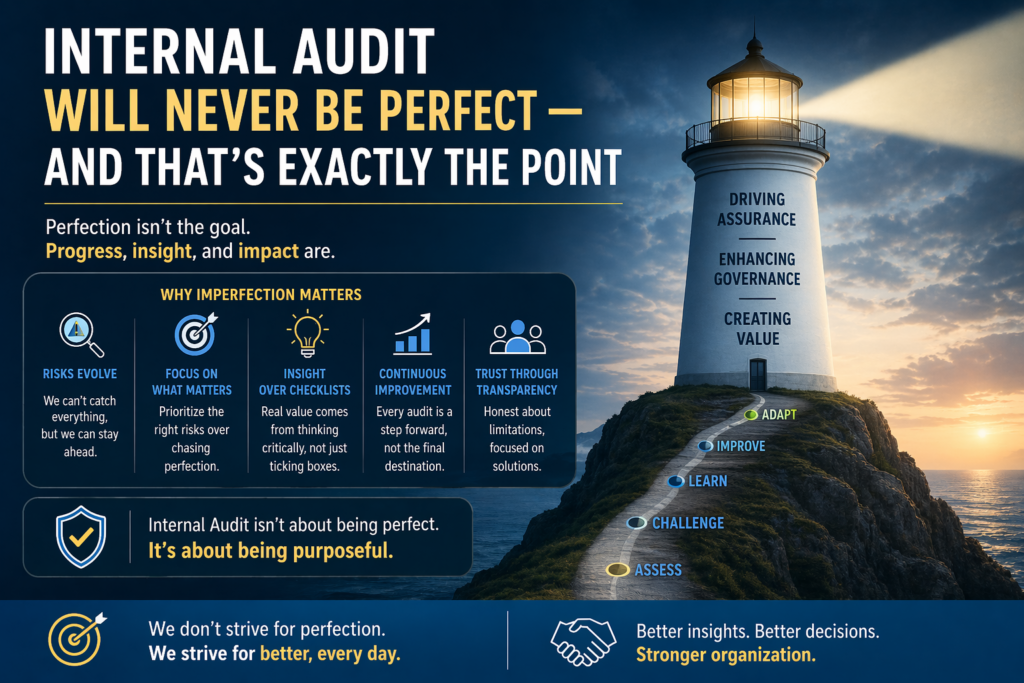
One of the most persistent misconceptions in governance is that internal audit should “cover everything.”
It can’t. And more importantly — it shouldn’t.
Across industries, internal audit functions are under increasing strain. According to global benchmarks, audit teams are often 20–30% under-resourced, while risk landscapes continue to expand across cyber, ESG, AI, third-party ecosystems, and geopolitical exposures.
The expectation, however, hasn’t changed. Boards still ask for comprehensive coverage, complete assurance, and zero surprises.
This mismatch is where audit loses relevance.
The most effective audit functions I’ve worked with don’t aim for perfection. They focus on prioritisation.
A regional bank I advised moved away from exhaustive audit coverage toward a risk-based model. By focusing on high-impact areas and leveraging data analytics, they reduced audit cycle time by 40% and reallocated effort toward cyber risk and third-party oversight. The result wasn’t just efficiency — it was better insight.
This reflects a broader shift in internal audit.
From coverage → to impact
From periodic reviews → to continuous auditing
From static plans → to dynamic risk alignment
Technology is enabling this shift. Data analytics and AI can now identify anomalies in real time — unusual transactions, control deviations, behavioural patterns. This allows audit teams to move from retrospective reviews to proactive risk detection.
But technology alone is not enough. The real transformation is cultural.
Audit functions must move from being perceived as “process checkers” to becoming risk navigators. That requires:
- stronger business understanding
- comfort with ambiguity
- the ability to challenge management constructively
Boards also need to rethink how they evaluate audit effectiveness.
Traditional metrics such as number of audits completed or issues identified are no longer sufficient. More relevant indicators include:
- coverage of high-risk areas
- speed of detecting control failures
- percentage of findings leading to meaningful change
The question is no longer: Did we audit everything?
It is: Did we focus on what mattered most?
In today’s environment, risk evolves faster than audit cycles. Trying to achieve perfection creates blind spots elsewhere.
Internal audit’s value lies not in completeness, but in clarity and prioritisation.
Organisations that recognise this are transforming audit into a strategic function — one that informs decisions, highlights emerging risks, and supports resilience.
Those that don’t risk turning audit into a compliance exercise with limited impact.
CTA: StraitsTribe helps internal audit teams evolve into agile, insight-driven functions that focus on real-time risk and strategic impact.

- ONLY 2 DAYS TO GO! Are you in? - September 30, 2026
- THE COUNTDOWN BEGINS – SESSION 1 OF OUR 12-PART WEBINAR SERIES! - September 30, 2026
- Raffles Education Institute Presents: Future-Ready Business Series 2026 - September 30, 2026