


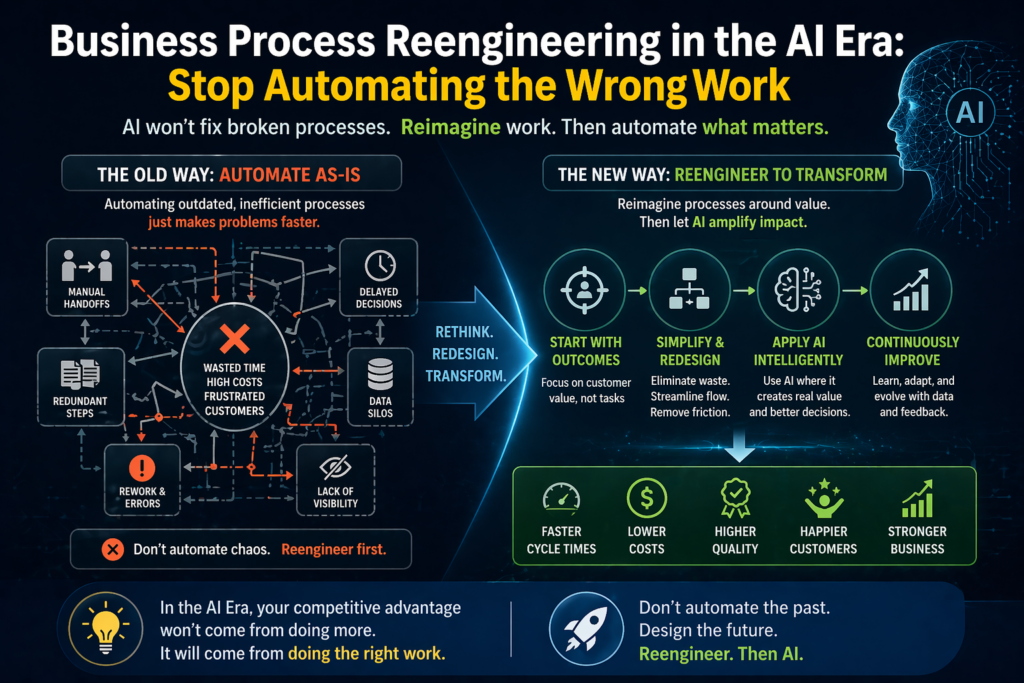
There is a pattern I see repeatedly: organisations rush to automate processes using AI — without questioning whether those processes should exist at all.
This is where Business Process Reengineering (BPR) becomes critical again.
The original principle of BPR was simple: don’t automate inefficiency — eliminate it. Yet in the current AI wave, many organisations are digitising legacy workflows instead of redesigning them.
The result? Faster inefficiency.
Technologies like process mining and AI now provide unprecedented visibility into how work actually happens. Studies show that organisations applying these tools effectively can achieve 60–80% reduction in cycle times.
But the real value comes from asking a more fundamental question:
If we were designing this process today, would it look the same?
In most cases, the answer is no.
A government agency I worked with reduced its procurement cycle from 45 days to 5 days. This was not achieved through automation alone. It required eliminating redundant approvals, redesigning workflows, and using AI for vendor matching and decision support.
This is what modern BPR looks like.
It is built on three principles:
- Zero-based design — start from scratch, not from legacy
- End-to-end thinking — optimise across functions, not within silos
- Human-AI integration — combine automation with judgment
Another critical aspect is governance. Rapid process redesign without proper controls can introduce new risks. Organisations must ensure:
- new processes have aligned control frameworks
- decision accountability is clearly defined
- performance metrics reflect outcomes, not just efficiency
The biggest barrier to BPR today is not technology — it is mindset.
Middle management often resists change because existing processes reflect established roles and authority structures. Successful transformation requires leadership to challenge these assumptions and create space for reinvention.
The organisations that succeed are not those that automate the fastest. They are the ones willing to rethink how work is structured.
AI amplifies capability — but only when applied to the right processes.
In a world of increasing complexity, the goal is not to do more work faster.
It is to do less work, better.
CTA: StraitsTribe supports organisations in redesigning processes for AI-enabled operating models that drive efficiency, control, and scalability.

- ONLY 2 DAYS TO GO! Are you in? - September 30, 2026
- THE COUNTDOWN BEGINS – SESSION 1 OF OUR 12-PART WEBINAR SERIES! - September 30, 2026
- Raffles Education Institute Presents: Future-Ready Business Series 2026 - September 30, 2026