


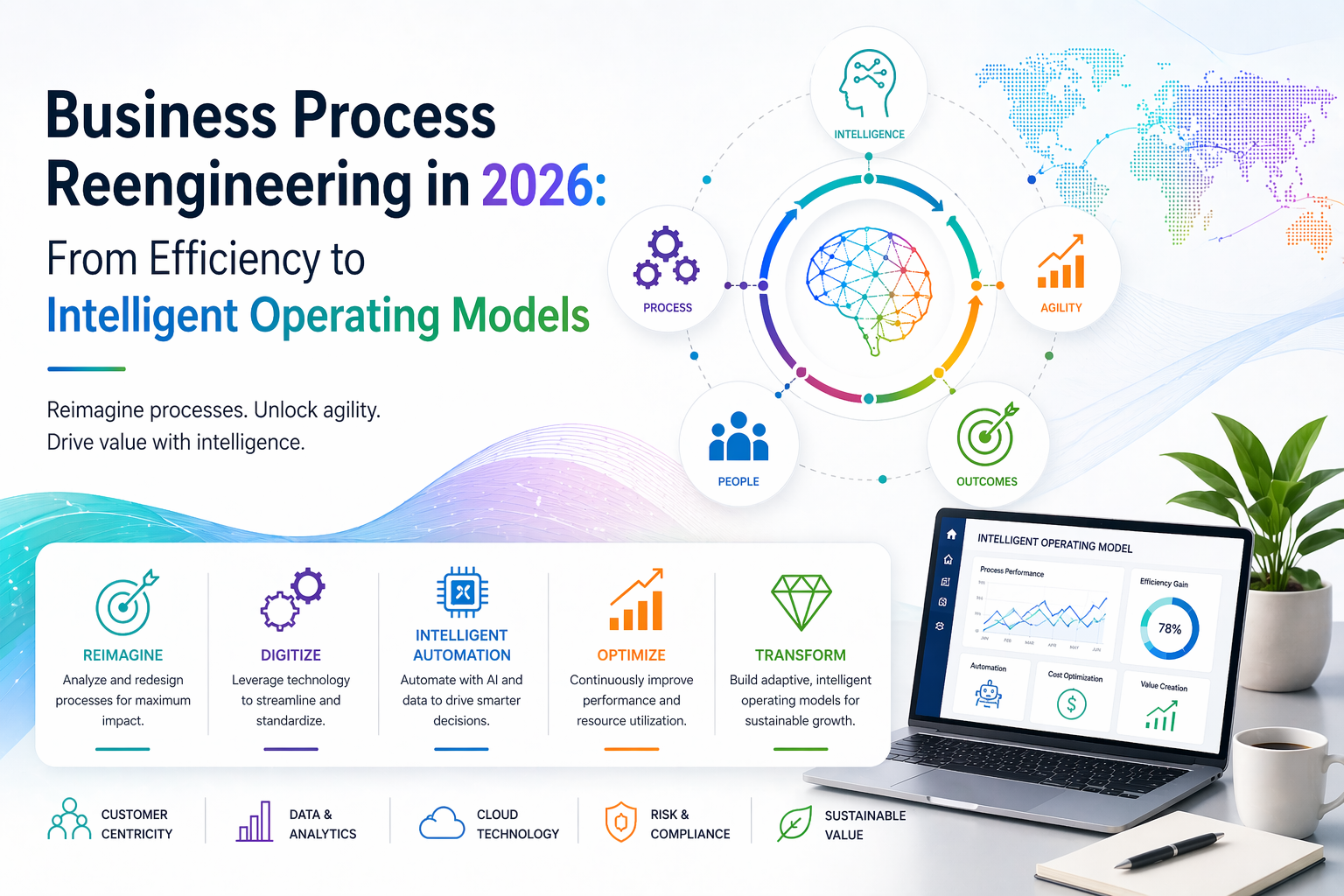
BPR Is No Longer Just About Efficiency
For years, Business Process Reengineering (BPR) was about efficiency—faster workflows, reduced costs, and incremental improvements.
That era is over.
In 2026, BPR is no longer about improving processes. It is about rethinking whether those processes should exist at all.
Across industries, AI and process mining expose a hard truth: many workflows were never designed for today’s speed, scale, or complexity. They are layered with approvals, redundancies, and manual dependencies that no longer make sense.
The most forward-looking organisations are not optimising these processes.
They are eliminating them.
The Rise of Zero-Based Process Design
This shift toward zero-based process design is redefining BPR. Instead of asking “How do we make this faster?” leaders are asking, “If we built this today, would we design it this way?”
In most cases, the answer is no.
Technology is accelerating this transformation. Process mining tools now provide real-time visibility into how work actually flows—not how it is documented. AI goes further, identifying inefficiencies, simulating redesign scenarios, and even automating decisions.
What was once a one-time transformation initiative is becoming a continuous capability.
This enterprise risk management blog also reflects a wider leadership concern: process redesign can no longer be separated from governance, accountability, and risk visibility.
Autonomous Workflows Are Changing Process Design
Another major shift is the rise of autonomous and agentic workflows.
AI systems are no longer limited to rule-based automation. They are now capable of interpreting context, prioritising actions, and executing decisions. This is enabling:
- autonomous control testing
- real-time exception handling
- dynamic workflow adjustments
In effect, processes are becoming self-correcting systems.
Governance Is Now Central to BPR
But this introduces a new challenge—governance.
When decisions are made by systems rather than people, accountability becomes less visible. Control points can be bypassed. Risks can scale faster than oversight mechanisms.
This is why BPR is increasingly converging with governance and risk management.
Process design is no longer just an operational concern. It is a control architecture decision.
Every redesigned workflow must answer:
- Where are the control points?
- Who is accountable for decisions?
- How are exceptions detected and escalated?
Without this, efficiency gains can quickly turn into risk exposure.
Human-AI Symbiosis Will Shape the Future of Work
There is also a human dimension that cannot be ignored.
The future of BPR is not full automation—it is human-AI symbiosis.
AI excels at scale, speed, and pattern recognition. Humans bring judgment, context, and ethical reasoning. The most effective operating models integrate both — automating routine decisions while reserving critical judgment for human oversight.
The organisations that succeed are those that redesign work around this balance.
A practical example illustrates the shift. A public sector entity redesigned its procurement process using process mining and AI-driven matching. By eliminating redundant approvals and automating vendor selection, it reduced cycle time from 45 days to under a week—while improving transparency and control.
The outcome was not just efficiency. It was better governance through better design.
This is the future of BPR.
It is not about doing the same work faster.
It is about doing fundamentally different work.
Organisations that embrace this shift will operate with greater agility, lower cost structures, and stronger control environments. Those that continue to optimise legacy processes will find themselves constrained by complexity.
The real question for leadership is no longer: How do we improve processes?
It is: What work should exist in the first place?
StraitsTribe helps organisations redesign operating models where processes, controls, and AI work together—creating intelligent, scalable, and risk-aware enterprises.

- ONLY 2 DAYS TO GO! Are you in? - September 30, 2026
- THE COUNTDOWN BEGINS – SESSION 1 OF OUR 12-PART WEBINAR SERIES! - September 30, 2026
- Raffles Education Institute Presents: Future-Ready Business Series 2026 - September 30, 2026