
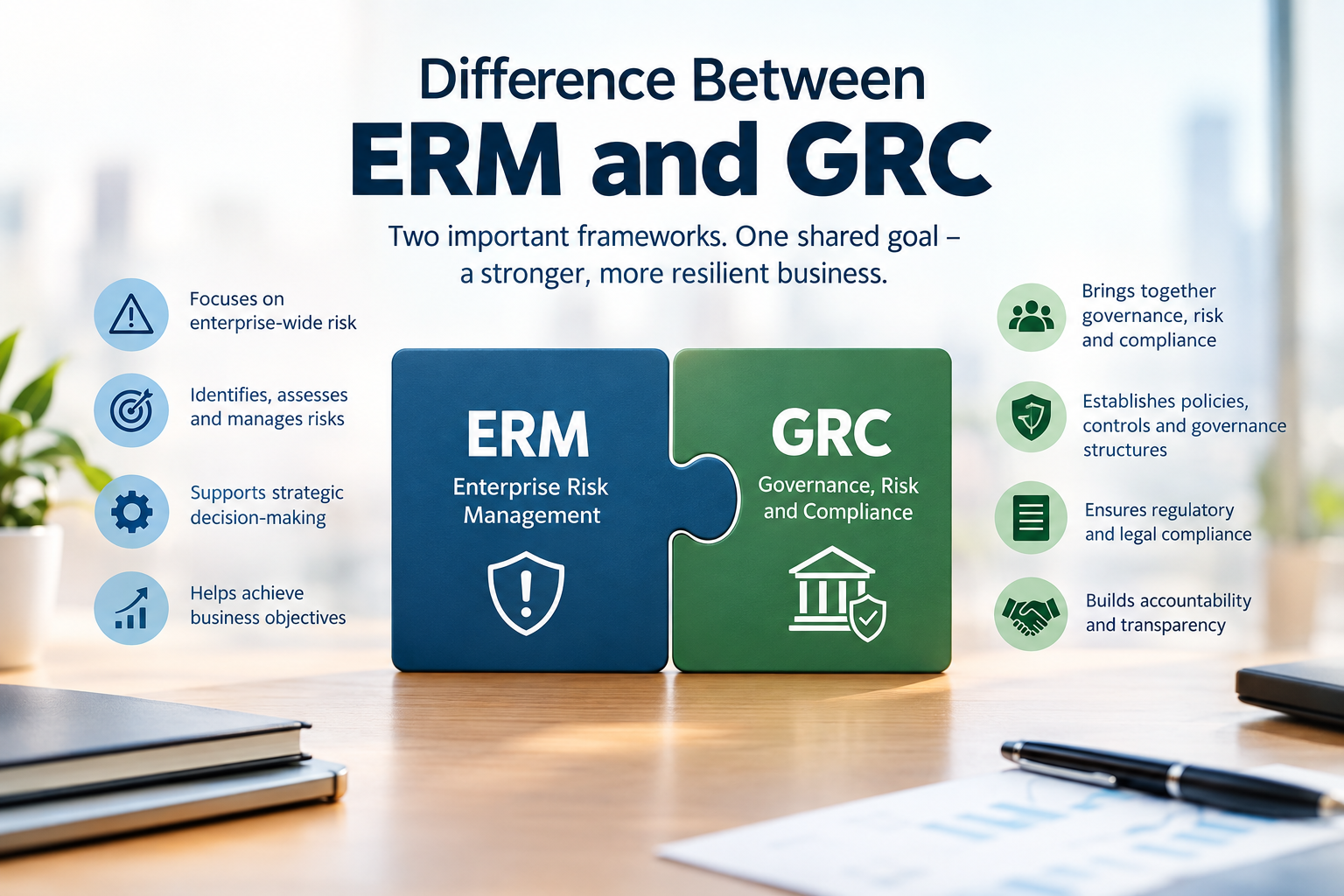
Understanding the difference between ERM and GRC is important for organisations that want to manage risk, strengthen governance, and maintain compliance. Although Enterprise Risk Management (ERM) and Governance, Risk and Compliance (GRC) are closely connected, they are not the same.
ERM primarily focuses on identifying, assessing, managing, and monitoring risks that could affect an organisation’s objectives. GRC takes a broader approach by bringing together governance practices, risk management, and compliance requirements within a coordinated framework.
In this guide, we explore the difference between ERM and GRC, their key functions, how they work together, and why organisations need both.
What Is Enterprise Risk Management (ERM)?
Enterprise Risk Management (ERM) is a structured approach to identifying, assessing, responding to, and monitoring risks across an organisation.
Instead of managing risks separately within individual departments, ERM considers risks at an enterprise-wide level. This helps leadership understand how different risks can interact and potentially affect strategic and operational objectives.
Key Objectives of ERM
ERM generally aims to:
- Identify significant organisational risks
- Assess the likelihood and potential impact of risks
- Develop appropriate risk responses
- Monitor emerging and changing risks
- Support informed business decision-making
- Connect risk management with organisational objectives
Examples of ERM Risks
An organisation may use ERM to address risks such as:
- Financial and market risks
- Operational risks
- Cybersecurity and technology risks
- Strategic risks
- Supply chain risks
- Reputational risks
- Business continuity risks
- Emerging risks
Why ERM Matters
Effective ERM helps organisations understand uncertainty before it becomes a major business problem. It also allows management and boards to consider risk when making strategic decisions.
ERM and Strategic Decision-Making
ERM is not simply about avoiding risk. It can also help organisations understand which risks are acceptable, which require mitigation, and which may create opportunities when managed appropriately.
What Is GRC?
GRC stands for Governance, Risk and Compliance. It is an integrated approach that helps organisations align decision-making, risk management, policies, controls, and compliance obligations.
GRC connects three closely related areas:
- Governance – How an organisation is directed, managed, and held accountable.
- Risk – How risks are identified, assessed, managed, and monitored.
- Compliance – How the organisation meets applicable laws, regulations, standards, policies, and contractual requirements.
Key Objectives of GRC
A GRC framework can help organisations:
- Establish clear governance structures
- Define roles and responsibilities
- Manage organisational risks
- Maintain regulatory and policy compliance
- Strengthen internal controls
- Improve accountability and reporting
- Create consistency across business functions
Examples of GRC Activities
GRC activities may include:
- Corporate governance
- Internal audit
- Regulatory compliance
- Policy management
- Risk assessments
- Internal controls
- Cybersecurity governance
- ESG governance
- Third-party risk management
- Compliance monitoring
What Is the Difference Between ERM and GRC?
The main difference between ERM and GRC is their scope and primary purpose.
ERM focuses specifically on managing risks across the enterprise and connecting those risks with business objectives and strategy.
GRC is broader. It brings governance, risk, and compliance together to create a coordinated approach to organisational management and accountability.
ERM vs GRC: Key Differences
| Area | ERM | GRC |
|---|---|---|
| Full Form | Enterprise Risk Management | Governance, Risk and Compliance |
| Primary Focus | Enterprise-wide risk | Governance, risk and compliance |
| Main Objective | Manage uncertainty and risk | Integrate governance, risk and compliance |
| Scope | Primarily risk management | Broader organisational framework |
| Strategic Connection | Strong focus on business objectives and strategy | Connects governance, risk and compliance with organisational objectives |
| Compliance | May consider compliance risks | Dedicated compliance component |
| Governance | Supports governance decisions | Governance is a core component |
| Typical Users | Risk teams, management, boards | Management, compliance, risk, audit, legal and governance teams |
How ERM and GRC Work Together
Although ERM and GRC have different scopes, they should not be treated as completely separate systems.
ERM can operate as an important component within a broader GRC approach. Risk information generated through ERM can support governance decisions and compliance activities.
ERM as Part of a Broader GRC Framework
A mature GRC approach can connect:
- Business objectives
- Risk management
- Policies
- Internal controls
- Compliance obligations
- Audit activities
- Management reporting
- Board oversight
Example: Cybersecurity Risk
Consider a company facing cybersecurity threats.
ERM may assess the cybersecurity risk, determine its potential impact, establish risk responses, and monitor the changing threat environment.
GRC may connect that risk assessment with cybersecurity policies, regulatory requirements, internal controls, governance responsibilities, audit processes, and management reporting.
The Result of Integration
When ERM and GRC work together, organisations can develop a more connected view of risk, governance, and compliance instead of managing each area in isolation.
Why Integration Is Important
Integrated approaches can reduce duplicated processes, improve visibility, clarify accountability, and provide decision-makers with more consistent information.
ERM and GRC in Modern Organisations
Today’s organisations face interconnected risks involving technology, regulation, supply chains, sustainability, cybersecurity, data, finance, and changing market conditions.
The Role of Technology
GRC and ERM activities can be supported by technology platforms that help organisations centralise information, automate workflows, monitor controls, track compliance requirements, and generate reports.
Data and Risk Visibility
Better access to risk and compliance information can help management identify relationships between risks, controls, policies, and business objectives.
Supporting Better Decisions
The objective is not simply to collect more data. Organisations need meaningful information that can support timely decisions by management and boards.
Moving Toward Integrated Risk Management
As risks become increasingly interconnected, organisations may benefit from connecting ERM processes with broader GRC activities rather than treating risk, governance, and compliance as isolated functions.
ERM vs GRC: Which One Does an Organisation Need?
The question is not necessarily whether an organisation should choose ERM or GRC.
Understanding the Different Roles
ERM provides a structured approach to managing enterprise-level risk.
GRC provides a broader framework for coordinating governance, risk, and compliance.
Using Both Approaches
An organisation can use ERM to strengthen its enterprise risk management capabilities while using GRC principles to connect those activities with governance and compliance.
Building a Coordinated Framework
The appropriate approach depends on factors such as organisational size, industry, regulatory environment, risk profile, governance structure, and strategic objectives.
The Importance of Organisational Context
There is no single GRC or ERM model that fits every organisation. The framework should reflect the organisation’s objectives, risks, regulatory obligations, and decision-making structure.
Key Takeaways: Difference Between ERM and GRC
The difference between ERM and GRC can be summarised simply:
- ERM focuses on enterprise-wide risk management.
- GRC combines governance, risk, and compliance.
- ERM helps organisations understand and respond to uncertainty affecting their objectives.
- GRC helps connect organisational governance, risk processes, controls, and compliance requirements.
- ERM and GRC can work together as part of a broader organisational management framework.
Understanding this distinction can help organisations design clearer responsibilities, stronger risk processes, and more connected governance and compliance practices.
Frequently Asked Questions About ERM and GRC
Is ERM the Same as GRC?
No. ERM focuses primarily on managing enterprise-wide risks, while GRC encompasses governance, risk, and compliance as an integrated framework.
Is ERM Part of GRC?
ERM can form an important part of a broader GRC framework. GRC can provide the structure for connecting risk management with governance and compliance activities.
What Is the Main Difference Between ERM and GRC?
The main difference is scope. ERM is centred on enterprise risk management, whereas GRC covers governance, risk, and compliance together.
Can a Company Have Both ERM and GRC?
Yes. Organisations can use ERM processes to manage enterprise risks while using GRC practices to coordinate governance, risk, compliance, controls, and reporting.
Why Is GRC Important for Risk Management?
GRC can connect risk management with governance responsibilities, policies, controls, compliance requirements, and organisational decision-making.
Final Thoughts
The difference between ERM and GRC becomes clearer when their roles are considered together. ERM provides a structured way to understand and manage risks across the enterprise, while GRC creates a broader framework connecting governance, risk, and compliance.
For organisations dealing with complex regulatory requirements, emerging risks, cybersecurity challenges, sustainability expectations, and business transformation, understanding how these disciplines interact can support more consistent and informed decision-making.

- ONLY 2 DAYS TO GO! Are you in? - September 30, 2026
- THE COUNTDOWN BEGINS – SESSION 1 OF OUR 12-PART WEBINAR SERIES! - September 30, 2026
- Raffles Education Institute Presents: Future-Ready Business Series 2026 - September 30, 2026