


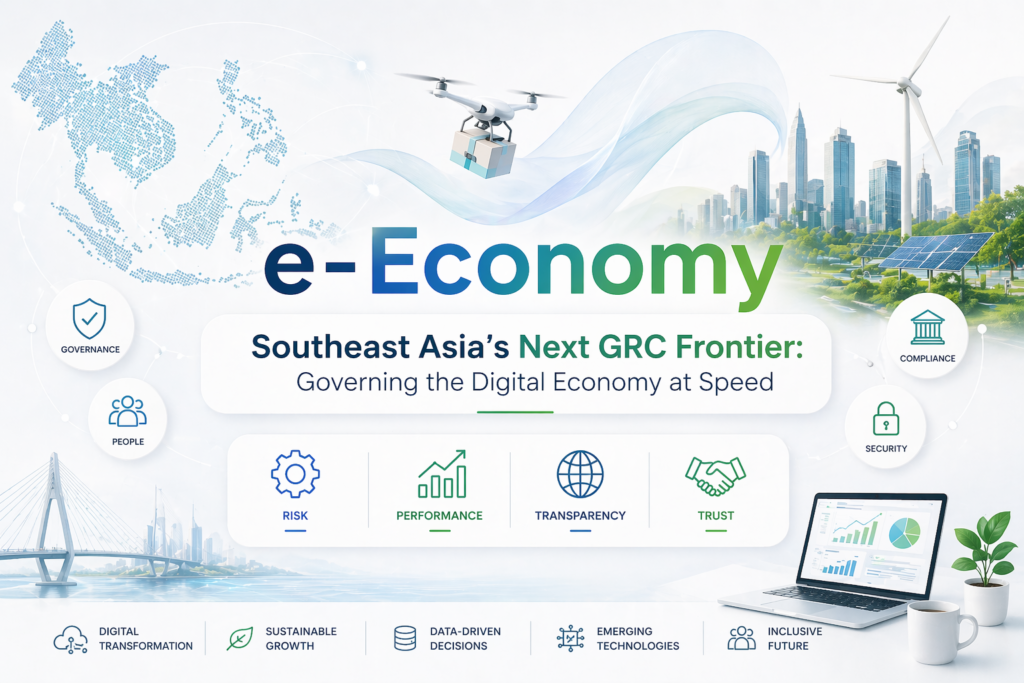
Southeast Asia is no longer a fast follower in governance. It is becoming a testing ground for how regulation keeps pace with digital growth.
Across Singapore, Indonesia, Malaysia, Vietnam, and Thailand, digital economies are scaling rapidly—driven by e-commerce, fintech, platform ecosystems, and cross-border data flows. With that growth comes a new kind of risk: speed without visibility.
Regulators across the region are responding decisively. In Singapore, the Monetary Authority of Singapore (MAS) continues to sharpen expectations on technology risk and operational resilience. Bank Negara Malaysia is strengthening oversight on digital financial services and third-party risk. Indonesia’s OJK is tightening governance requirements across financial institutions, particularly around data and consumer protection.
The signal is clear: growth is welcome—but not at the cost of control.
What makes Southeast Asia unique is the convergence of three forces.
First, digital adoption is accelerating faster than governance maturity. Organisations are deploying AI, cloud platforms, and digital ecosystems at scale. But oversight mechanisms—controls, monitoring, accountability—are still catching up. This creates blind spots where risk can accumulate unnoticed.
Second, regulation is becoming more outcome-driven. Regulators are no longer satisfied with policies and frameworks. They are asking: Do your controls actually work in real time? Can you demonstrate it? This is pushing organisations toward continuous monitoring, stronger data governance, and auditable decision-making.
Third, accountability is moving upward. Recent enforcement actions across the region show a clear trend—boards and senior management are increasingly in scope. Governance is no longer something that can be delegated downward.
A practical example illustrates this shift. A regional financial institution faced regulatory scrutiny not because controls were absent, but because they were not operating effectively in practice. The issue was not design—it was execution visibility. This is becoming a common theme.
In response, leading organisations are evolving their GRC models in three ways:
- moving from periodic reviews to continuous risk sensing
- integrating technology risk into enterprise-wide governance frameworks
- strengthening board-level visibility through real-time dashboards and metrics
There is also a growing recognition that data is now at the centre of governance. Whether it is customer data, transaction data, or ESG data, the ability to manage, validate, and monitor data flows is becoming a critical control point.
For Southeast Asia, this presents both a challenge and an opportunity.
The challenge is complexity—multiple jurisdictions, evolving regulations, and diverse operating environments. The opportunity is leadership. Organisations that build adaptive, technology-enabled governance models can move faster, scale more confidently, and earn greater trust from regulators and investors.
The question boards should be asking is no longer: Are we compliant?
It is: Can we demonstrate control in a real-time, digital environment?
Because in Southeast Asia’s digital economy, governance is no longer a back-office function.
It is a strategic enabler of growth.
StraitsTribe works with organisations across Southeast Asia to design adaptive GRC frameworks that keep pace with digital transformation—turning governance into a driver of trust, resilience, and scalable growth.

- ONLY 2 DAYS TO GO! Are you in? - September 30, 2026
- THE COUNTDOWN BEGINS – SESSION 1 OF OUR 12-PART WEBINAR SERIES! - September 30, 2026
- Raffles Education Institute Presents: Future-Ready Business Series 2026 - September 30, 2026