


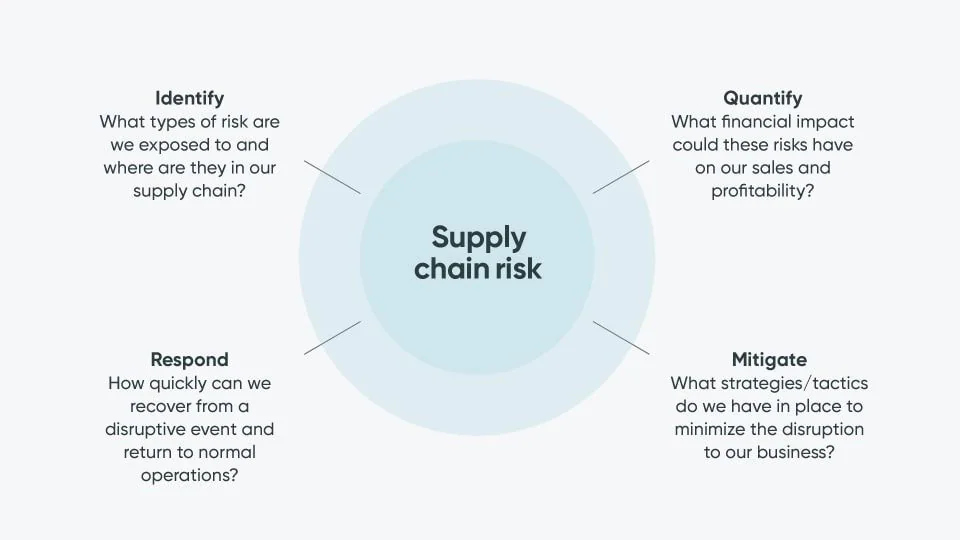
Supply chains used to be managed by procurement teams. Today, they are shaped by geopolitics, climate events, and systemic dependencies.
This shift has elevated supply chain risk to the boardroom.
Global disruptions now cost the economy an estimated $1.7 trillion annually. For trade-dependent economies like Singapore, the impact is even more pronounced.
The challenge is no longer visibility at Tier 1 suppliers. It is understanding interconnected risk across entire ecosystems.
A recent disruption in semiconductor production in Malaysia had cascading effects on industries across Southeast Asia, including financial services infrastructure. This illustrates how supply chain risk is no longer linear — it is networked.
Traditional risk management approaches are no longer sufficient.
Leading organisations are moving toward resilience engineering, which focuses on the ability to absorb and recover from disruption.
Key strategies include:
- diversifying supplier bases across geographies
- maintaining strategic inventory buffers
- implementing real-time tracking and monitoring systems
- conducting scenario-based stress testing
A manufacturing firm I advised shifted from a single-source supplier model to a dual-source strategy across different countries. While costs increased slightly, supply availability improved to over 95% reliability, significantly reducing operational risk.
Technology is also playing a critical role. AI-driven demand forecasting, IoT-based tracking, and blockchain for traceability are enabling better visibility and responsiveness.
But resilience is not just a technical issue — it is a governance issue.
Boards must:
- define acceptable levels of supply chain risk
- review resilience metrics regularly
- integrate supply chain risk into enterprise risk frameworks
The key question is no longer: Are we efficient?
It is: Are we resilient under stress?
Organisations that invest in resilience will be better positioned to navigate volatility. Those that optimise only for cost will remain vulnerable.
CTA: StraitsTribe helps organisations design resilient, risk-aware supply chains aligned with strategic and governance priorities.

- ONLY 2 DAYS TO GO! Are you in? - September 30, 2026
- THE COUNTDOWN BEGINS – SESSION 1 OF OUR 12-PART WEBINAR SERIES! - September 30, 2026
- Raffles Education Institute Presents: Future-Ready Business Series 2026 - September 30, 2026