


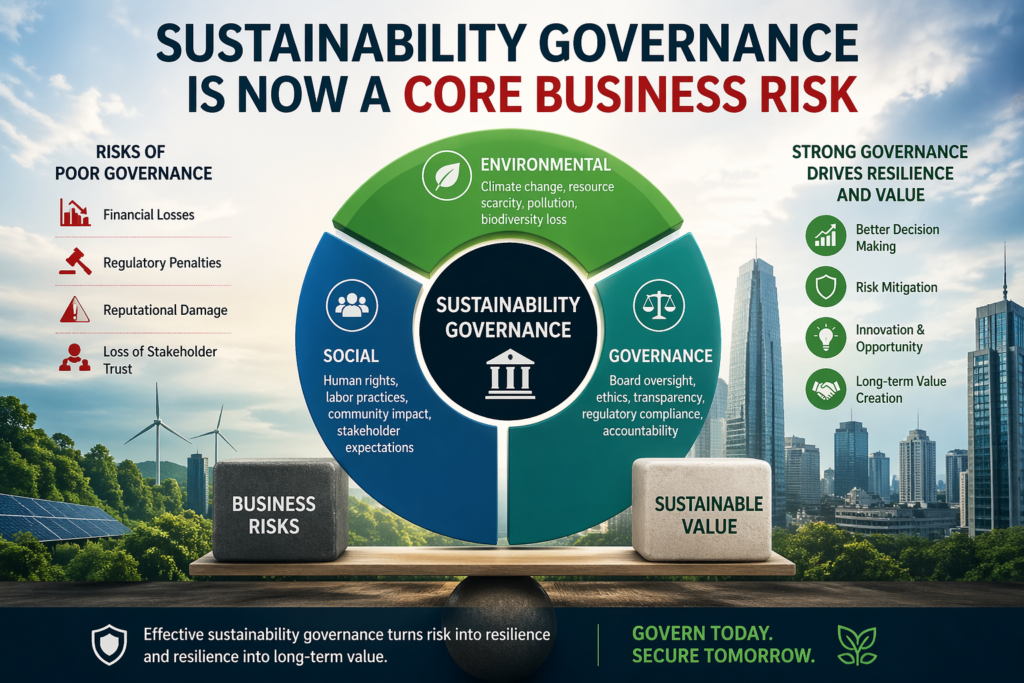
Sustainability has moved decisively from ESG reporting into the core of enterprise risk. What was once a narrative-driven exercise is now being tested through regulation, investor scrutiny, and operational realities.
The turning point is clear. The EU’s Corporate Sustainability Reporting Directive (CSRD) now applies to over 50,000 companies, with penalties reaching up to €10 million or 5% of global turnover. Across Asia, regulators in Singapore, Malaysia, and beyond are aligning with similar expectations — credible, auditable, and decision-useful ESG data.
This shift is exposing a gap in many organisations.
Most have sustainability strategies. Many have ambitious targets. But when you examine operations — procurement, supplier selection, capital allocation — the alignment is often inconsistent. That disconnect creates real risk.
A global retailer provides a useful example. Despite strong sustainability commitments, inconsistencies in supplier practices led to regulatory scrutiny and investor pressure. The issue was not intent. It was governance failing to extend into execution.
The biggest challenge in sustainability today is not awareness. It is integration.
Boards are now expected to treat sustainability as a strategic variable, not a reporting obligation. This requires:
- linking ESG metrics to capital allocation decisions
- embedding sustainability into enterprise risk frameworks
- ensuring data integrity across value chains
Data is a major issue. Scope 3 emissions — which can account for 70–90% of total environmental impact — remain difficult to measure and verify. Yet regulators and investors increasingly expect transparency in this area.
Another shift is accountability. Sustainability oversight is moving from management to the board. Audit committees are expected to validate ESG disclosures with the same rigour as financial reporting. Investors are also becoming more selective. Large asset managers are already tying capital allocation to credible ESG performance, not just disclosures.
In this environment, sustainability becomes more than compliance. It becomes a test of organisational resilience.
Organisations that embed ESG into decision-making will be better positioned to manage regulatory change, supply chain disruptions, and investor expectations. Those that treat it as a reporting exercise will face increasing scrutiny.
Sustainability is no longer about communicating what you intend to do.
It is about demonstrating what your organisation is structurally capable of delivering.
StraitsTribe helps organisations embed sustainability into governance, risk, and operational decision-making—turning ESG from reporting into measurable business performance.

- ONLY 2 DAYS TO GO! Are you in? - September 30, 2026
- THE COUNTDOWN BEGINS – SESSION 1 OF OUR 12-PART WEBINAR SERIES! - September 30, 2026
- Raffles Education Institute Presents: Future-Ready Business Series 2026 - September 30, 2026