


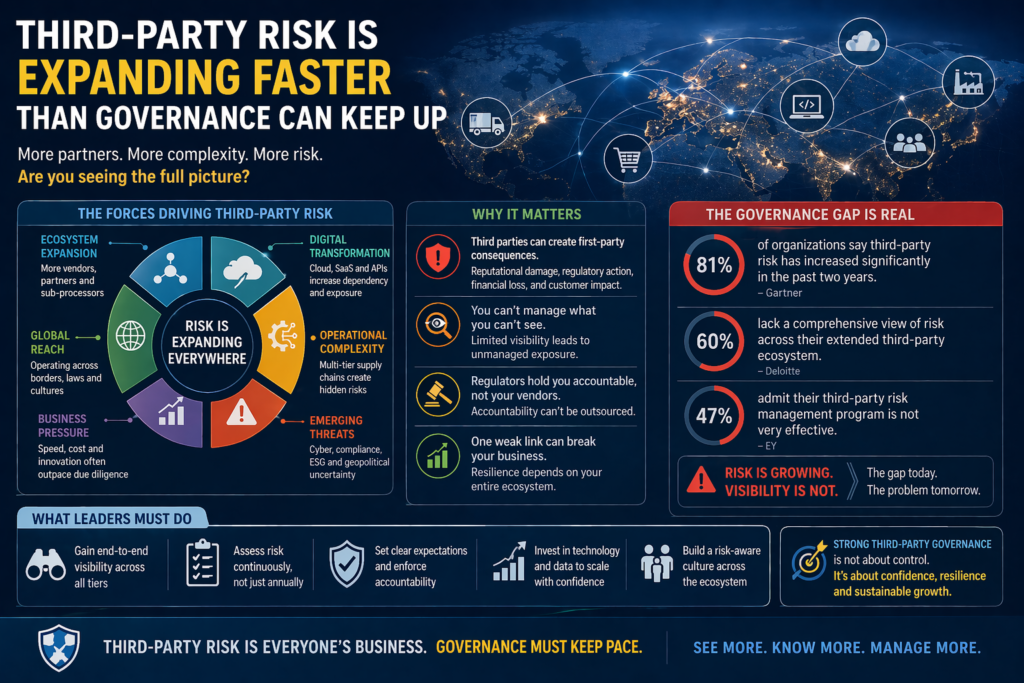
Modern organisations operate within vast ecosystems of vendors, partners, and service providers.
In many cases, these third parties outnumber internal employees.
This creates a significant challenge: risk is no longer contained within the organisation.
Studies indicate that over 70% of cyber incidents involve third parties, yet governance frameworks often remain fragmented and reactive.
A regional bank transitioned from spreadsheet-based vendor tracking to an automated third-party risk management platform. The results were immediate:
- identification of significantly more high-risk vendors
- reduction in onboarding time from 60 days to 10 days
- improved regulatory compliance
This highlights the importance of moving toward structured, technology-enabled TPRM.
Effective third-party risk management includes:
- risk-based vendor segmentation
- continuous monitoring across cyber, financial, and ESG dimensions
- integration with enterprise risk systems
Another common gap is over-reliance on self-assessment questionnaires. These provide limited assurance and can create a false sense of security.
Leading organisations supplement this with:
- external risk intelligence
- real-time monitoring tools
- contractual controls aligned with risk exposure
Boards must also recognise that third-party risk is dynamic. Vendors change, environments evolve, and new risks emerge.
The focus must shift from periodic reviews to continuous oversight.
The key question is: Do we understand the risk our ecosystem introduces?
Organisations that manage this well gain not just protection, but operational efficiency and stronger partnerships.
Those that don’t risk exposure beyond their direct control.
CTA: StraitsTribe helps organisations build scalable, enterprise-wide third-party risk management frameworks.

- ONLY 2 DAYS TO GO! Are you in? - September 30, 2026
- THE COUNTDOWN BEGINS – SESSION 1 OF OUR 12-PART WEBINAR SERIES! - September 30, 2026
- Raffles Education Institute Presents: Future-Ready Business Series 2026 - September 30, 2026