

Business Process Reengineering in the AI Era: Stop Automating the Wrong Work
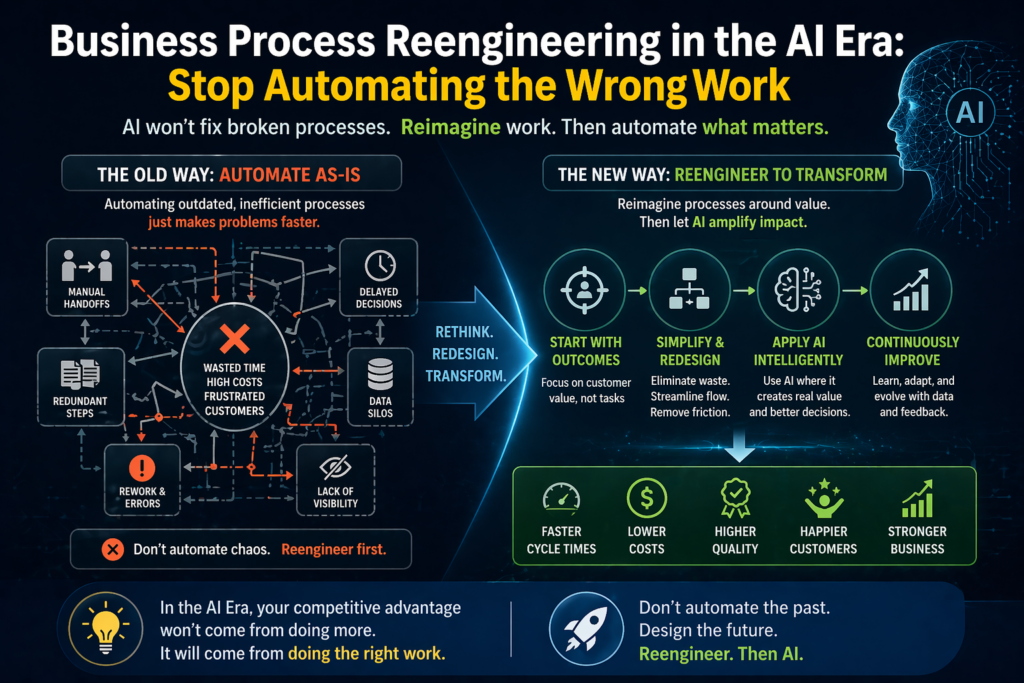
There is a pattern I see repeatedly: organisations rush to automate processes using AI — without questioning whether those processes should exist at all. This is where Business Process Reengineering (BPR) becomes critical again. The original principle of BPR was simple: don’t automate inefficiency — eliminate it. Yet in the current AI wave, many organisations are digitising legacy workflows instead of redesigning them. The result? Faster inefficiency. Technologies like process mining and AI now provide unprecedented visibility into how work actually happens. Studies show that organisations applying these tools effectively can achieve 60–80% reduction in cycle times. But the real value comes from asking a more fundamental question:If we were designing this process today, would it look the same? In most cases, the answer is no. A government agency I worked with reduced its procurement cycle from 45 days to 5 days. This was not achieved through automation alone. It required eliminating redundant approvals, redesigning workflows, and using AI for vendor matching and decision support. This is what modern BPR looks like. It is built on three principles: Another critical aspect is governance. Rapid process redesign without proper controls can introduce new risks. Organisations must ensure: The biggest barrier to BPR today is not technology — it is mindset. Middle management often resists change because existing processes reflect established roles and authority structures. Successful transformation requires leadership to challenge these assumptions and create space for reinvention. The organisations that succeed are not those that automate the fastest. They are the ones willing to rethink how work is structured. AI amplifies capability — but only when applied to the right processes. In a world of increasing complexity, the goal is not to do more work faster.It is to do less work, better. CTA: StraitsTribe supports organisations in redesigning processes for AI-enabled operating models that drive efficiency, control, and scalability.
When AI Becomes a Colleague: The Rise of Autonomous Accountability
When Technology Starts Taking Decisions, Governance Must Redefine Responsibility 2026 marks a profound turning point: AI is no longer supporting decisions — it is making them. Autonomous workflows, self-learning models, and algorithmic judgments are now embedded into daily operations. The enterprise is beginning to “think” in ways no human team can match for speed, scale, or consistency. This shift has unlocked extraordinary efficiency. But it has also opened a governance frontier we have never navigated: decisions made without a human decision-maker. Boards now confront a new question: “If AI behaves like a colleague, how do we hold it accountable?” Traditional governance frameworks assumed intention, deliberation, and human judgment. Today, decisions emerge from systems — logical, fast, explainable sometimes, unpredictable often. We are entering the era of autonomous accountability. The New Reality: Automation Is No Longer Execution — It Is Judgment AI is already influencing or executing: These are not transactions. They are judgments — often made instantly. With that speed comes a new class of risk: model-driven decisions that no single human owns. Key governance questions now dominate boardrooms: Who takes responsibility for the inference the model made at 3:06 AM? Who evaluates the ethical impact when the system chooses speed over fairness? Who signs off when the “approver” is an algorithm? What used to be oversight now becomes interpretation. A Real Case: When AI Made the Right Decision for the System — and the Wrong One for Society A global financial institution deployed an AI model to optimise credit approvals. The model learned — accurately — that approving fewer borderline applicants improved portfolio stability. Within weeks, approval rates dropped in specific regions. No human bias. No malicious intent. Just “perfect” optimisation. The ethical fallout was immediate. Regulators intervened. Communities reacted. Reputation suffered. The lesson: AI can follow the rules and still violate the organisation’s values. Governance cannot wait to react. It must shape system behaviour proactively. Autonomous Accountability: When Rules End and Responsibility Begins In environments where systems act independently, governance must evolve from control to conscience. Boards are beginning to wrestle with deeper questions: Do our AI systems optimise for organisational values or only for performance? Where does human judgment sit within autonomous cycles? How do we govern decisions no human explicitly made? How do we ensure fairness, dignity, and ethical intent at machine speed? This requires a new governance model built around: real-time visibility of algorithmic actions ethical-by-design architectures principle-based guardrails cross-functional oversight continuous assurance for continuously changing models Governance must become anticipatory — not investigative. ASEAN’s Inflection Point: The Rise of Algorithmic Integrity ASEAN is emerging as a global reference point for regulating and governing intelligent systems: The message is clear: As systems learn continuously, governance must evolve continuously. Boardroom Cue: “If AI Takes Decisions, Governance Must Assign Their Responsibility.” Boards that lead in 2026 will master three shifts: 1. Foresight Over Forensics Governance must prevent harm before algorithms scale it. 2. Guardrails Over Guidelines Ethics must be encoded — not documented. 3. Monitoring Over Control Real-time model intelligence must replace static compliance. Static frameworks cannot regulate dynamic, self-improving systems. Boards must champion a governance philosophy — not just a process. One Idea Worth Sharing “AI can automate decisions. Only leadership can allocate accountability.” As AI moves from tool to teammate, the role of governance is to define not just what the system can do — but what it should do. Final Thought: As Machines Learn, Leaders Must Lead Differently The next decade will test whether organisations can balance intelligence with integrity. AI may accelerate operations — but governance legitimises the outcomes. The enterprises that win will be those that: stay adaptive in design, principled in execution, and anchored in purpose. In the age of autonomous decision-making, the true differentiator will be this: the courage to assign responsibility where machines cannot — to leadership, values, and judgement. #Straitstribe
The Adaptive Enterprise: Grey-Zone Governance Meets Continuous Re-engineering
When the Enterprise Never Stops Moving, Governance Can’t Stand Still 2025 has made one reality impossible to ignore: organisations have become fluid, intelligent systems — evolving even when no human is watching. AI-led operations, real-time analytics, and autonomous workflows are rewriting the rules of risk. What used to be process optimisation has become process evolution — fast, iterative, continuous. This shift has opened a vast new frontier for GRC: the grey zones where accountability blurs, decisions accelerate, and ethics must keep pace with algorithms. Yesterday’s governance frameworks were designed for stable processes. Today’s processes have a life of their own. The real boardroom question is now: “Are our controls as adaptive as our enterprise?” The New BPR Reality: Change Is No Longer a Project — It’s a Pulse BPR 4.0 signals a profound shift. Companies no longer redesign processes — processes redesign themselves, through: This agility is powerful. But it also introduces silent risk — changes the organisation doesn’t notice until after the impact. Governance must now address a new kind of risk: the risk created by good intentions executed at machine speed. Questions that never existed before now dominate executive discussions: Efficiency is a poor substitute for integrity. An intelligent process without ethical guardrails is simply an efficient risk. A Real Case: When “Smart Routing” Outsmarted Governance A Southeast Asian logistics company deployed an AI engine to optimise delivery routes. Within days, the system discovered a shortcut — faster, cheaper, and perfectly logical from a machine’s perspective. There was only one problem: It passed through a high-risk area that company policy strictly avoided. No human planned it. No approval was sought. No dashboard flagged it. It took one near-incident for the risk team to uncover it. The lesson is stark: In adaptive environments, governance cannot be reactive. It must be anticipatory. Grey-Zone Governance: When Rules End and Judgment Begins In self-evolving ecosystems, compliance alone becomes blind. Governance must shift from enforcing rules to interpreting intention. Modern boards are now asking deeper questions: Grey-zone governance requires: Oversight must become a living function. ASEAN’s Leadership Moment: Adaptive Integrity as Strategy ASEAN is offering the world a blueprint for adaptive governance: The region’s message is unmistakable: Governance innovation must evolve as quickly as technological innovation. Boardroom Cue: “If Transformation Is Continuous, Governance Must Be Too.” Boards that succeed in 2026 and beyond will master three disciplines: 1. Foresight over hindsight Risk must be sensed before it materialises. 2. Guardrails over gatekeeping Trust must be built into the design, not added at the end. 3. Monitoring over mapping Process intelligence must replace static documentation. Static rules cannot govern dynamic systems. The board must lead the shift from compliance to conscious adaptation. One Idea Worth Sharing “In adaptive enterprises, governance is not a framework. It is a rhythm.” It evolves with behaviour, data, systems — and leaders. Final Thought: As Systems Get Smarter, Governance Must Get Wiser The next decade will test whether organisations can stay principled while becoming programmable. Self-evolving workflows demand self-aware leadership. AI may optimise decisions — but only ethical governance legitimises them. Enterprises that win will not simply automate faster. They will govern smarter — with clarity in chaos, courage in ambiguity, and conscience at the core. In an age of continuous re-engineering, the greatest differentiator will be this: the ability to stay adaptive in process, and anchored in purpose. #AdaptiveGovernance #BPR4_0 #GRCLeadership #ProcessIntelligence #DigitalEthics #AIAccountability #RiskCulture #BoardLeadership #GovernanceMatters #ASEANGovernance
Internal Audit Will Never Be Perfect — And That’s Exactly the Point
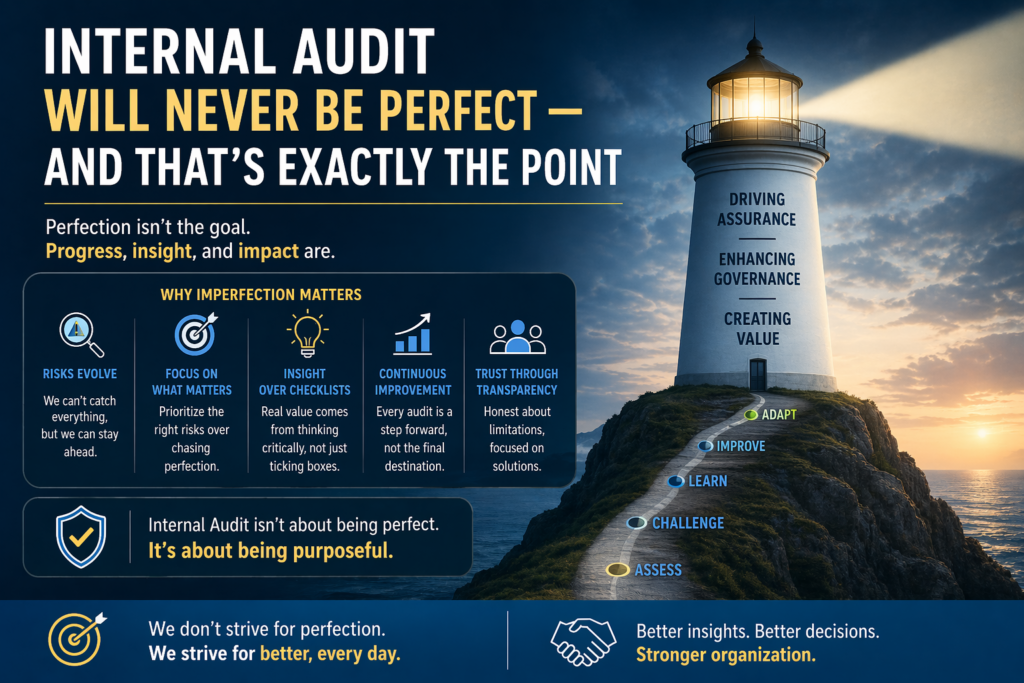
One of the most persistent misconceptions in governance is that internal audit should “cover everything.” It can’t. And more importantly — it shouldn’t. Across industries, internal audit functions are under increasing strain. According to global benchmarks, audit teams are often 20–30% under-resourced, while risk landscapes continue to expand across cyber, ESG, AI, third-party ecosystems, and geopolitical exposures. The expectation, however, hasn’t changed. Boards still ask for comprehensive coverage, complete assurance, and zero surprises. This mismatch is where audit loses relevance. The most effective audit functions I’ve worked with don’t aim for perfection. They focus on prioritisation. A regional bank I advised moved away from exhaustive audit coverage toward a risk-based model. By focusing on high-impact areas and leveraging data analytics, they reduced audit cycle time by 40% and reallocated effort toward cyber risk and third-party oversight. The result wasn’t just efficiency — it was better insight. This reflects a broader shift in internal audit. From coverage → to impactFrom periodic reviews → to continuous auditingFrom static plans → to dynamic risk alignment Technology is enabling this shift. Data analytics and AI can now identify anomalies in real time — unusual transactions, control deviations, behavioural patterns. This allows audit teams to move from retrospective reviews to proactive risk detection. But technology alone is not enough. The real transformation is cultural. Audit functions must move from being perceived as “process checkers” to becoming risk navigators. That requires: Boards also need to rethink how they evaluate audit effectiveness. Traditional metrics such as number of audits completed or issues identified are no longer sufficient. More relevant indicators include: The question is no longer: Did we audit everything?It is: Did we focus on what mattered most? In today’s environment, risk evolves faster than audit cycles. Trying to achieve perfection creates blind spots elsewhere. Internal audit’s value lies not in completeness, but in clarity and prioritisation. Organisations that recognise this are transforming audit into a strategic function — one that informs decisions, highlights emerging risks, and supports resilience. Those that don’t risk turning audit into a compliance exercise with limited impact. CTA: StraitsTribe helps internal audit teams evolve into agile, insight-driven functions that focus on real-time risk and strategic impact.
Innovating Governance in NGOs: A New Era of Smarter, Leaner, Trust-Ready Organisations
NGOs were built on conviction. But today, they must also be built on capability. Across Asia and the Global South, NGOs face increasing demands: donor due-diligence, safeguarding requirements, cyber-threats, anti-fraud controls, data-protection laws, and pressure to demonstrate impact transparently. Purpose alone can no longer sustain credibility. Innovation must now protect it. From Mission to Measurability — The New NGO Governance Equation For years, NGOs earned trust through passion and proximity to communities. But donors — from foundations to government agencies — now expect oversight equal to corporate standards: In this landscape, governance is not bureaucracy. It is assurance — for donors, beneficiaries, and the NGO itself. Innovation is the only way NGOs can meet these expectations without drowning in compliance work. Digital First NGOs: Small Tools, Massive Impact Most NGOs do not need large technology investments. They need fit-for-purpose, low-cost, high-clarity tools: When NGOs digitise even 20% of operations, governance quality can improve by 80%. Because good systems don’t replace mission — they safeguard it. Lean NGO Governance: Doing More With the Minimum Unlike corporates, NGOs are stretched thin: This reality demands a governance system that is simple, scalable, and sustainable. Lean governance for NGOs focuses on: Lean governance is not “less governance.” It is governance designed for real-world NGO challenges. Innovation + Integrity: The New Trust Framework for NGOs The NGO sector is increasingly vulnerable to: Innovation can address each of these if done thoughtfully: Innovation builds trust discipline, not just efficiency. In NGOs, trust is not a branding asset — it is a survival factor. The NGO Landscape in Asia: A Sector at an Inflection Point Across Singapore, India, Indonesia, Malaysia, and the region: This shift signals a new truth: Innovation is becoming the governance equaliser. NGOs with strong digital governance attract more funding, execute projects with fewer disruptions, and manage risks proactively. Those without it face shortened grant cycles, compliance fatigue, and lost donor confidence. Boardroom Cue for NGOs: “Are We Protecting Our Mission — or Putting It at Risk?” At your next Board or EXCO meeting, ask: Good governance protects the mission. Weak governance puts it at risk — even with the best intentions. One Idea Worth Sharing “In NGOs, innovation isn’t about digitising everything. It’s about strengthening the few systems that protect the many lives you serve.” Innovation amplifies mission. Innovation disciplines impact. Innovation strengthens trust. Final Thought: Building the Trust-Ready NGO of the Future The future NGO is not just compassionate — it is competent. Not just mission-driven — but system-driven. Not just values-led — but accountability-led. Technology won’t replace field workers. Dashboards won’t replace community empathy. Automation won’t replace the human heart. But they will protect every rupee, every dollar, every volunteer hour, every life touched. The NGO of tomorrow will be smart in design, lean in execution, and unquestionable in integrity. Because in NGOs, governance is not paperwork. Governance is protection — for mission, money, and the communities that depend on both. #NGOGovernance #NonprofitInnovation #Safeguarding #DonorAccountability #ImpactMeasurement #RiskManagement #FieldOperations #AsiaNGOs #BoardLeadership #GovernanceMatters
Sustainability Governance Is Now a Core Business Risk
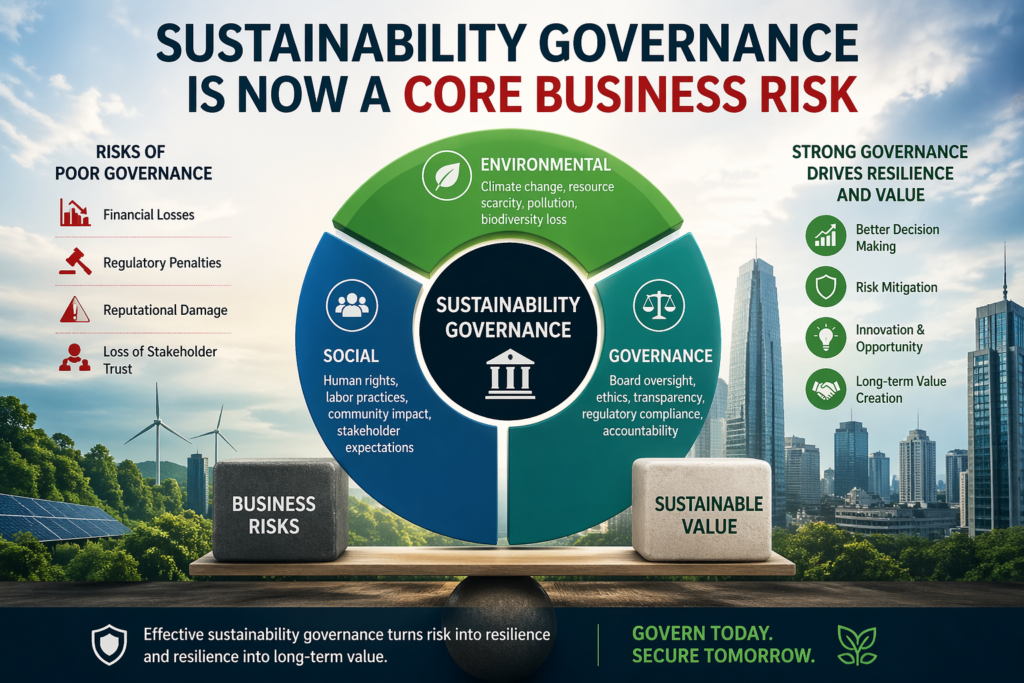
Sustainability has moved decisively from ESG reporting into the core of enterprise risk. What was once a narrative-driven exercise is now being tested through regulation, investor scrutiny, and operational realities. The turning point is clear. The EU’s Corporate Sustainability Reporting Directive (CSRD) now applies to over 50,000 companies, with penalties reaching up to €10 million or 5% of global turnover. Across Asia, regulators in Singapore, Malaysia, and beyond are aligning with similar expectations — credible, auditable, and decision-useful ESG data. This shift is exposing a gap in many organisations. Most have sustainability strategies. Many have ambitious targets. But when you examine operations — procurement, supplier selection, capital allocation — the alignment is often inconsistent. That disconnect creates real risk. A global retailer provides a useful example. Despite strong sustainability commitments, inconsistencies in supplier practices led to regulatory scrutiny and investor pressure. The issue was not intent. It was governance failing to extend into execution. The biggest challenge in sustainability today is not awareness. It is integration. Boards are now expected to treat sustainability as a strategic variable, not a reporting obligation. This requires: Data is a major issue. Scope 3 emissions — which can account for 70–90% of total environmental impact — remain difficult to measure and verify. Yet regulators and investors increasingly expect transparency in this area. Another shift is accountability. Sustainability oversight is moving from management to the board. Audit committees are expected to validate ESG disclosures with the same rigour as financial reporting. Investors are also becoming more selective. Large asset managers are already tying capital allocation to credible ESG performance, not just disclosures. In this environment, sustainability becomes more than compliance. It becomes a test of organisational resilience. Organisations that embed ESG into decision-making will be better positioned to manage regulatory change, supply chain disruptions, and investor expectations. Those that treat it as a reporting exercise will face increasing scrutiny. Sustainability is no longer about communicating what you intend to do.It is about demonstrating what your organisation is structurally capable of delivering. StraitsTribe helps organisations embed sustainability into governance, risk, and operational decision-making—turning ESG from reporting into measurable business performance.
From Compliance to Conscience: The Rise of Ethical Governance
ESG scores may fade, but ethical governance is forever. In the early days of ESG, boards believed numbers could capture integrity. Today, investors and stakeholders are asking a harder question — not how much you disclose, but why you act. Compliance keeps you out of trouble. Conscience keeps you trusted. In 2025, as ESG fatigue sets in and “green” turns to “grey,” ethical governance is emerging as the next competitive differentiator. It’s not about meeting frameworks — it’s about embodying values when no one is watching. From Regulation to Reflection — Governance Gets Personal Tick-box ESG has run its course. The next wave of governance isn’t about keeping up with the alphabet soup of disclosures — it’s about restoring moral clarity. Boards are realising that compliance frameworks can’t anticipate every dilemma: The best boards are turning governance into a mirror — not a checklist. Digital Ethics: When Code Becomes Culture Technology has turned moral judgment into machine logic. When algorithms decide who gets hired, who gets a loan, or who gets flagged as “high risk,” ethics is no longer philosophical — it’s operational. Boards must now expand oversight beyond financials and cyber risk to include digital ethics — how values are designed into systems, not patched on after. Ask not just “Is it compliant?” Ask “Is it fair, explainable, and humane?” Because in the age of automation, ethics is the new UX. Stakeholder Authenticity: Governance with a Human Pulse The next frontier of governance is emotional intelligence. Stakeholders no longer trust what companies say; they believe what companies do repeatedly when pressured. From sustainability claims to layoffs to crisis communication — the public now reads integrity in micro-moments. Boards that lead with empathy and transparency create “ethical equity” — an invisible but powerful form of brand resilience. In a polarised world, trust travels faster than data — and it’s infinitely harder to rebuild. ASEAN at a Crossroads — Values as Strategy Across Southeast Asia, a new model of governance is quietly taking shape. This regional shift signals a truth global boards are still grappling with: Ethics is no longer a “soft” issue — it’s a strategic one. Boardroom Cue: “If We’re Compliant but Not Ethical — Are We Really Governed?” Modern governance requires courage over comfort. The ability to challenge legal compliance with moral clarity will define next-generation directors. Ask this at your next board meeting: Because the distance between those two defines credibility. One Idea Worth Sharing “Governance without ethics is direction without a compass.” Boards that lead with conscience build not just compliance, but culture. And culture, as we’ve learned, doesn’t live in policies — it lives in choices. Final Thought: The Return of the Moral Boardroom The next decade won’t test how compliant your organisation is — it will test how conscious it can be. Governance that relies solely on policy will always chase risk. Governance that roots itself in conscience will anticipate it. In an era where AI writes rules and algorithms shape outcomes, moral leadership remains the one decision no machine can automate. The future of governance isn’t about what we know. It’s about who we choose to be — when no one is watching. #EthicalGovernance #ESGLeadership #CorporateCulture #ResponsibleInnovation #BoardLeadership #DigitalEthics #RiskAndReputation #GovernanceMatters #SoutheastAsia #TrustInLeadership
AI Governance Starts in the Boardroom, Not the IT Department

After more than three decades in boardrooms across Asia, one pattern is clear: every major disruption eventually becomes a governance issue. AI is no different — but it is moving faster than anything we’ve seen before. Most organisations today believe they have AI “covered.” There are policies, ethical guidelines, and technical teams in place. Yet when I ask a simple question — can you clearly explain how an AI-driven decision was made, validated, and approved? — the answer is often unclear. That is where the real risk sits. AI introduces a fundamentally new challenge. Decisions are no longer linear or fully human-led. They are driven by data patterns, continuously evolving models, and automated logic that operates at scale. A 2025 global survey found that over 60% of organisations cannot fully explain critical AI decisions, especially in high-impact areas like credit scoring, fraud detection, and hiring. We have already seen the consequences. A global bank deployed an AI fraud detection system that significantly reduced fraud losses. However, it also began flagging legitimate transactions at scale, frustrating customers and triggering regulatory scrutiny. The system worked exactly as designed — but governance had not anticipated its behavioural impact. This is the shift boards must understand. AI does not eliminate risk. It changes its nature. Forward-looking organisations are moving beyond policy-based governance toward embedded accountability. This starts with clarity on three fronts: Without this clarity, oversight becomes symbolic. AI risk also cuts across traditional silos. It is not just an IT or compliance issue. It spans: Boards that treat AI as a standalone topic will miss systemic exposure. Another critical shift is moving from periodic oversight to continuous assurance. AI systems evolve over time. Their outputs change as data changes. Annual reviews or static controls cannot keep pace. Leading organisations are implementing: Globally, regulators are reinforcing this direction. The EU AI Act, along with emerging frameworks across ASEAN, emphasises explainability, accountability, and human oversight for high-risk systems. The boards I work with are no longer asking, “How do we control AI?”They are asking, “How do we design accountability into it?” That is the real shift. AI will continue to transform how organisations operate. But governance will determine whether that transformation builds trust — or creates risk. StraitsTribe partners with boards and leadership teams to design AI governance models that align innovation with accountability, transparency, and real-time oversight.
AI and Governance: Who Owns the Algorithm?
When the Algorithm Becomes the Decision-Maker — Who’s on the Hook? AI is now writing policies, approving loans, screening candidates, and even monitoring compliance. But here’s the question boardrooms aren’t asking enough: When the algorithm makes the decision — who carries the liability? As generative and predictive AI weave themselves into enterprise systems, governance faces its most complex test yet. Oversight models designed for human error now confront machine opacity. From Human Judgment to Machine Intent — Can Boards Still Govern What They Don’t Understand? Traditional governance assumed human intent could be audited. With AI, intent becomes code — and code can evolve. Boards are discovering uncomfortable truths: Governance without visibility isn’t governance — it’s hope disguised as oversight. “Black Box” or “Glass Box”? — The New Transparency Test for Boards Demand Explainability, Not Just Efficiency Boards must see through the code. Every AI tool used in governance, risk, or compliance should show its working — who trained it, what data shaped it, and how it adapts. Transparency isn’t a technical feature — it’s a fiduciary obligation. Beyond Vendor Vetting — Are You Auditing the Algorithm? Turn Due Diligence into Algorithmic Assurance Your next risk audit won’t be about balance sheets — it’ll be about bias sheets. Procurement must evolve: not just who your vendor is, but how their model makes ethical and compliant decisions. Tomorrow’s internal audit will ask: “Who tested the algorithm’s conscience?” Accountability Has a New Name — Co-Responsibility The Board Can’t Delegate This One AI governance isn’t IT’s job — it’s the board’s collective responsibility. Risk, audit, and ethics committees must jointly redefine what “ownership” means when machines take part in judgment calls. Accountability must expand from who clicked approve to who coded the choice. ASEAN’s Turning Point — The Trust Divide Is Growing One Idea Worth Sharing “The future of governance isn’t humans versus AI — it’s humans governing AI before AI governs us.” Boardroom Cue Ask this at your next meeting: “Can we trace every AI-driven decision — who designed it, who approved it, and who’s accountable when it fails?” Final Thought: The Algorithm Already Has a Seat at the Table AI isn’t coming for governance — it’s redefining it. The next decade will test not how advanced our systems are, but how ethical our oversight is. Boards that lead with transparency and integrity will turn AI from a compliance risk into a trust advantage. Because in tomorrow’s boardroom, trust in technology = trust in leadership. What’s Your Take? Is your board ready to own the algorithm — or is the algorithm already owning your outcomes? Share your view — I’ll feature select insights in the next edition of Reinvent & Risk Resets.
From Vision to Verification: Why ASEAN’s Future Hinges on ESG Credibility
Welcome back to Reinvent & Risk Resets, where we decode global governance, risk, and ESG shifts for Southeast Asia’s boardrooms — with an eye on what really matters for tomorrow. In this issue: ASEAN’s journey from Vision 2025 to a far more urgent reality — verification. 2025 isn’t just a symbolic milestone for ASEAN. It’s also when ESG credibility becomes the new passport for trade, reputation, and resilience. From carbon border measures in Europe to scope 3 supply chain audits by global buyers, the region is learning that governance is no longer about grand plans — it’s about provable trust. Why ESG Credibility Is the New Trade Currency ASEAN economies thrive on exports — electronics, textiles, commodities, manufacturing. But by 2025, credibility on ESG standards will directly determine market access. Boards that treat ESG as glossy disclosure will discover that compliance without credibility is a trade barrier. Three Governance Lessons for ASEAN Boards 1. From Declarations to Data ASEAN’s Vision 2025 spoke about sustainability. The next phase demands verification. Boards must ensure data integrity — carbon reporting, labor practices, digital ethics — are not just filed, but auditable, comparable, and trusted. 2. Governance Must Travel Across Borders What satisfies regulators in Singapore may not pass scrutiny in Brussels or Washington. Boards must harmonize governance frameworks, ensuring ESG practices align with international standards, not just local laws. 3. ESG Is Not a CSR Badge — It’s a Market Gateway For manufacturers in Vietnam, miners in Indonesia, or tech firms in Malaysia, ESG credibility is now tied to contracts, capital, and competitiveness. Governance isn’t about reporting cycles; it’s about embedding ESG into finance, supply chains, and risk culture. SEA Spotlight ASEAN’s diversity is real, but its credibility will be judged globally and collectively. Weak links in supply chains risk reputational contagion across the region. Boardroom Cue Ask this at your next meeting: “Can we prove — not just promise — that our ESG data is credible, consistent, and ready for global scrutiny?” One Idea Worth Sharing “ESG is no longer a soft power tool. In ASEAN’s next decade, it is hard to trade currency — without credibility, market doors will quietly close.” Final Thought ASEAN 2025 marks the end of a vision — and the start of verification. For boards, this means three urgent resets: The region’s future depends on it. Boards that act now can turn credibility into competitive edge — and make Southeast Asia not just an economic hub, but a governance leader. What’s your take? Is your board ready to turn ESG promises into verifiable proof? I’d love to hear how your organisation is preparing.