
Enterprise Risk Management: Building Resilient Businesses in Malaysia, Singapore and Southeast Asia
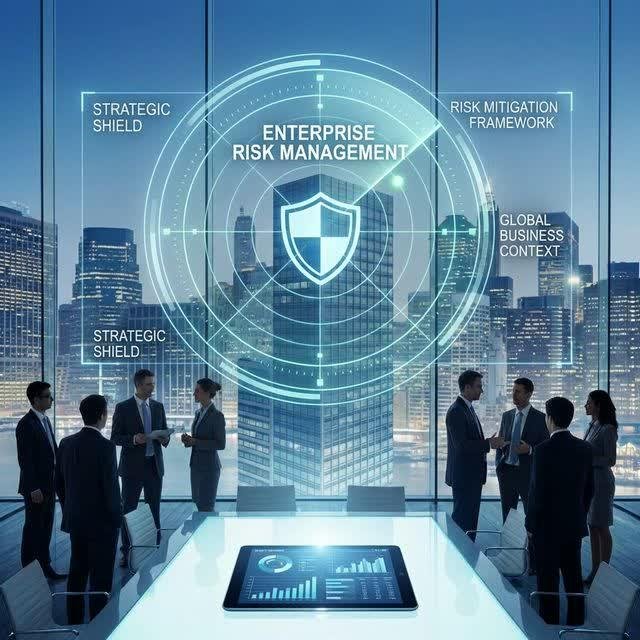
Why Enterprise Risk Management Matters Today Businesses today operate in an environment where risks can emerge from technology, cybersecurity, regulations, financial uncertainty, supply-chain disruptions and changing market conditions. This makes Enterprise Risk Management an essential part of long-term business strategy. A strong Enterprise Risk Management framework helps organisations identify potential risks, assess their impact, and take proactive measures before those risks affect business performance. Enterprise Risk Management in Malaysia For organisations operating in Malaysia, Enterprise risk management Malaysia has become increasingly important as businesses navigate regulatory changes, digital transformation, cybersecurity threats and evolving market expectations. An effective risk management approach allows Malaysian organisations to understand their risk exposure and develop appropriate controls while supporting sustainable business growth. Enterprise Risk Management in Singapore Singapore’s position as a major financial and business hub makes effective risk management particularly important. Enterprise risk management Singapore focuses on helping organisations manage operational, financial, regulatory, technology and strategic risks in an increasingly complex business environment. Organisations in Singapore need risk frameworks that are not only focused on compliance but also support better decision-making and business resilience. The Role of Internal Audit Consulting in SEA Across Southeast Asia, organisations are increasingly looking beyond traditional compliance-based auditing. Internal audit consulting SEA can help businesses evaluate their internal controls, identify weaknesses and strengthen governance and risk management processes. Internal audit consulting can also provide independent insights that help management and boards understand whether their existing risk controls are working effectively. Key Elements of Effective Enterprise Risk Management An effective Enterprise Risk Management framework should include: Building a Strong Risk Culture Enterprise Risk Management is not only the responsibility of a risk or audit department. It requires participation across the organisation. Employees, management and board members should understand the organisation’s key risks and their role in managing them. A strong risk culture helps organisations identify problems earlier and respond to emerging risks more effectively. Enterprise Risk Management for a Resilient Future Whether an organisation operates in Malaysia, Singapore or across Southeast Asia, Enterprise Risk Management can play an important role in building resilience and supporting sustainable growth. By combining effective governance, strong internal controls, proactive risk assessment and independent assurance, businesses can become better prepared for uncertainty while making more informed strategic decisions. Conclusion Enterprise Risk Management is becoming an essential business discipline across Southeast Asia. Organisations that invest in effective risk frameworks, strong internal controls and professional internal audit capabilities can better manage uncertainty and create a more resilient foundation for future growth.
AI Is Exposing Fake GRC
Why the Future of Governance Belongs to Judgment, Not Administration What if the greatest disruption to your GRC function isn’t a new regulation-but Artificial Intelligence? For years, organisations believed their Governance, Risk and Compliance capability was becoming more mature because it employed more people, produced more reports, and generated more evidence. Then AI arrived. Almost overnight, activities that consumed entire teams-policy mapping, control testing, evidence collection, regulatory comparisons, issue tracking, report writing and compliance monitoring-could be completed in minutes. AI didn’t suddenly make GRC obsolete. It simply exposed something many organisations had never questioned. Much of what we called “GRC” was never governance at all. It was administration. The Illusion of Busy Governance Across many organisations, success has traditionally been measured by activity. When more audits were completed, more controls were tested, more policies reviewed, more evidence collected, more reminders sent; the dashboards looked impressive. Yet very little of this actually improved business decisions because updating policy documents is not strategy. These activities support governance. They are not governance itself. AI is forcing organisations to recognise that distinction. AI Doesn’t Replace Good GRC It Replaces Administrative GRC. Large Language Models can already: • Compare regulations across multiple jurisdictions • Map controls against ISO 27001, NIST or COSO • Generate draft risk assessments • Analyse thousands of policy documents • Identify missing controls • Monitor compliance continuously • Produce executive reports within minutes These tasks once justified significant manual effort. Because the real value of GRC has never been producing documentation. Its value lies in helping organisations make better decisions under uncertainty. What AI Cannot Replace Despite astonishing advances, AI still struggles where experienced professionals create the greatest value. Most importantly, AI cannot exercise accountable judgement. Governance has always been about judgement. We simply buried that truth beneath years of paperwork. Five Characteristics of AI-Era GRC 1. Continuous Assurance Instead of reviewing controls once every quarter, organisations will monitor them continuously. Risk becomes visible as it emerges-not months later. 2. Judgment Becomes the Premium Skill As AI performs the administrative work, professionals become interpreters rather than processors. The question shifts from: “Did a control fail?” to “What does this mean for the business?” 3. Governance Moves Earlier The highest-performing GRC teams will participate during strategy, product design and digital transformation-not after implementation. Prevention creates more value than inspection. 4. Speed Becomes a Governance Metric Competitive organisations cannot wait six months for governance approval. Future-ready GRC functions will enable safe decisions at business speed. Governance will increasingly be measured by how quickly it helps the organisation move with confidence. 5. Smaller Teams. Greater Impact. The administrative layer will shrink. What remains will be a leaner, more experienced team focused on advisory, strategic thinking and enterprise resilience. The Boardroom Shift Boards should now ask different questions. Instead of asking: “How many audits were completed?” Ask: Those questions reveal far more about governance maturity than any compliance dashboard. Boardroom Cue At your next Audit & Risk Committee meeting, ask one simple question: “If AI automated every repetitive activity in our GRC function tomorrow, what unique value would still require human expertise?” The answer may tell you whether your organisation has built a governance capability-or merely a compliance factory. One Idea Worth Sharing Artificial Intelligence will not eliminate Governance, Risk and Compliance. It will eliminate the illusion that administration equals governance. The professionals who thrive over the next decade will not be those who managed the most controls. They will be those whose judgement shapes better business decisions. Final Thought Every major technological shift removes work that machines can perform more efficiently. The printing press reduced scribes. The spreadsheets transformed accounting. Artificial Intelligence is now redefining Governance, Risk and Compliance. This is not the end of the profession. It is the beginning of a far more influential one. As routine work disappears, the importance of human judgement, ethical leadership, strategic thinking and business partnership will only increase. Perhaps the future of GRC isn’t about proving compliance. It is about proving value. I’d be interested to hear from fellow Board Directors, Audit Committee Members, Chief Risk Officers, Internal Auditors and Compliance Leaders: Which GRC activities in your organisation should AI own-and which must always remain human? #StraitsTribe #REI #AI #ArtificialIntelligence #GRC #Governance #RiskManagement #Compliance #InternalAudit #BoardLeadership #DigitalTransformation #FutureOfWork #ContinuousAssurance #CorporateGovernance
Dr Sivanesan Singapore & Malaysia: A Trusted GRC Consultant and Governance Advisor for Future-Ready Organizations
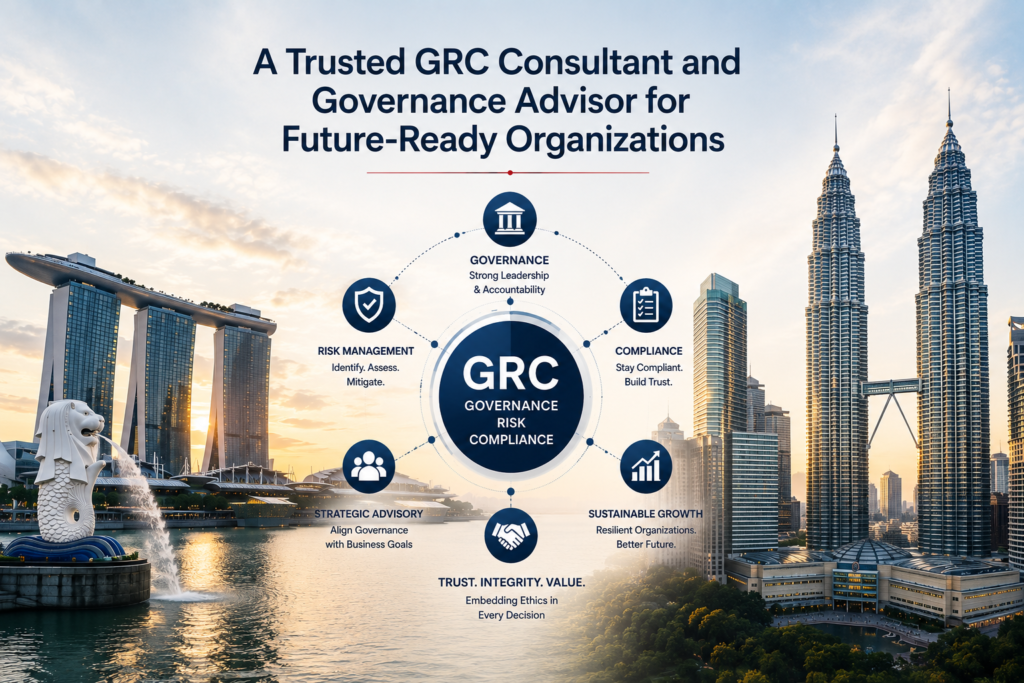
In today’s rapidly evolving business environment, organizations face increasing pressure to strengthen governance, manage risks effectively, and comply with ever-changing regulations. Companies across Singapore and Malaysia need more than compliance – they need strategic leadership that transforms governance into a competitive advantage. Dr Sivanesan Singapore has built a reputation for helping organizations achieve sustainable growth through practical Governance, Risk, and Compliance (GRC) strategies. As a highly respected GRC consultant Singapore, GRC consultant Malaysia, governance advisor Singapore, and governance advisor Malaysia, Dr. S. Sivanesan works closely with boards, executives, and leadership teams to develop resilient governance frameworks that drive long-term success. Why Governance Matters More Than Ever Governance is no longer just about following policies and regulations. It is about creating a culture of accountability, transparency, and responsible decision-making. Modern organizations must prepare for: Strong governance enables organizations to navigate uncertainty while protecting stakeholders and creating business value. Businesses that invest in governance today are better positioned to innovate, scale, and respond confidently to future challenges. Dr Sivanesan Singapore: Delivering Practical GRC Excellence With decades of international leadership experience, Dr Sivanesan Singapore has advised organizations ranging from government agencies and educational institutions to multinational corporations and SMEs. Rather than offering one-size-fits-all solutions, his consulting approach focuses on practical implementation, measurable outcomes, and sustainable governance improvements. Organizations engage him for: His methodology combines international best practices with local business realities, making every recommendation actionable and relevant. Supporting Businesses Across Singapore and Malaysia Organizations operating across Southeast Asia require governance strategies that reflect regional regulations, cultural differences, and business objectives. As a recognized GRC consultant Singapore and GRC consultant Malaysia, Dr. Sivanesan helps organizations strengthen governance while remaining agile in competitive markets. His consulting services help organizations: Likewise, as an experienced governance advisor Singapore and governance advisor Malaysia, he partners with leadership teams to align governance initiatives with strategic business goals rather than treating compliance as a standalone function. This integrated approach enables organizations to reduce risks while creating opportunities for innovation and sustainable growth. A Modern Approach to Governance, Risk, and Compliance Today’s governance challenges extend beyond traditional compliance requirements. Organizations must also address: Dr. Sivanesan believes governance should empower organizations-not slow them down. His consulting philosophy emphasizes: By integrating governance into everyday decision-making, organizations become stronger, more agile, and better prepared for long-term success. Why Organizations Choose Dr Sivanesan Singapore and Malaysia Organizations across industries continue to work with Dr Sivanesan Singapore because of his ability to simplify complex governance challenges and deliver practical solutions that create measurable business value. Key reasons clients choose him include: Whether organizations require a trusted GRC consultant Singapore, an experienced GRC consultant Malaysia, a strategic governance advisor Singapore, or a knowledgeable governance advisor Malaysia, Dr. S. Sivanesan provides the expertise needed to strengthen governance, manage risks effectively, and build resilient organizations for the future. As governance continues to evolve alongside technology, regulatory expectations, and stakeholder demands, organizations that invest in robust GRC practices will be better equipped to achieve sustainable success. Dr. Sivanesan remains committed to helping businesses across Singapore and Malaysia build stronger governance foundations that support innovation, accountability, and long-term growth.
FROM GATEKEEPER TO GROWTH PARTNER
The Evolution of GRC from Control Function to Business Enabler What if the biggest risk facing your organisation isn’t cyber, compliance, or AI… but the way your GRC function is perceived? For decades, Governance, Risk and Compliance has been built on a simple premise: protect the organisation. So, we designed stronger controls. We wrote more policies. We added more approvals. We measured compliance. We audited adherence. And somewhere along the way, GRC unintentionally earned a reputation it never wanted. It became the department that slowed projects, questioned every decision, and was invited into the conversation only after the important decisions had already been made. The irony is striking. The very function created to help organisations succeed gradually became associated with saying “No.” But business has changed. And GRC must change with it. The organisations outperforming their competitors today are not governed by more controls. They are governed by better decisions. That is why the role of GRC is undergoing its most significant transformation in more than two decades-from gatekeeper to growth partner. The Compliance Era Is Ending For years, success in GRC was measured by familiar metrics. These remain important. But they tell us very little about whether governance is actually helping the business perform better. Boards today are asking very different questions. None of these questions can be answered through compliance reports alone. They require governance that is embedded within business strategy-not operating alongside it. The New Measure of GRC Success The question is no longer: “Are we compliant?” The better question is: “Are we making better business decisions because GRC is involved?” That single shift changes the purpose of governance. Compliance becomes an outcome. Business performance becomes the objective. Leading organisations are no longer asking GRC simply to identify risks. They expect GRC to help leadership understand uncertainty, evaluate strategic options, and move forward with confidence. In other words, governance is becoming a decision-support capability. What Growth-Partner GRC Looks Like High-performing GRC teams think differently. They arrive early-before strategy becomes execution. They simplify governance instead of adding bureaucracy. They translate risk into commercial language. They help leaders understand not only what could go wrong-but also what could go right. They ask: “How can we make this initiative succeed safely?” rather than “Why shouldn’t we do this?” This subtle change transforms the relationship between business and governance. Instead of being perceived as a control function, GRC becomes a trusted adviser. Not an obstacle but an accelerator. Five Ways Modern GRC Creates Business Value 1. Better Strategic Decisions Governance provides clarity when uncertainty is highest. Rather than overwhelming executives with risk registers, it helps leadership evaluate trade-offs and make informed choices with confidence. 2. Faster Innovation Innovation without governance creates exposure. Governance without innovation creates stagnation. The best organisations achieve both. GRC enables responsible innovation by helping teams understand acceptable risk-not avoid all risk. 3. Greater Organisational Resilience Resilience is no longer about recovering quickly. It is about continuing to deliver critical services while disruption is unfolding. Modern GRC integrates operational resilience, cyber resilience, third-party oversight, and business continuity into a single strategic capability. 4. Less Friction. More Agility. Every duplicated approval. Every unnecessary control. Every manual compliance process. Every disconnected governance framework. These create hidden costs. High-performing GRC functions remove friction rather than adding it. 5. Sustainable Growth Be it expansion into new markets, Digital transformation, Artificial Intelligence, Strategic partnerships, every opportunity introduces uncertainty. The role of GRC is not to eliminate uncertainty. It is to ensure the organisation can move forward confidently despite it. The Boardroom Shift This transformation also changes the questions boards should be asking. Instead of reviewing compliance dashboards in isolation, boards should ask: These questions reveal far more about governance maturity than the number of completed audits ever will. Boardroom Cue At your next Board or Audit Committee meeting, ask one simple question: “Can we identify three strategic business decisions over the past twelve months that were demonstrably better because GRC was involved?” If the answer is unclear, governance may still be measuring success through compliance rather than contribution. One Idea Worth Sharing The most valuable GRC teams aren’t remembered for the risks they prevented. They are remembered for the confidence they gave leaders to pursue opportunities others were afraid to take. Final Thought Governance was never intended to slow business. Its purpose has always been to help organisations achieve their objectives responsibly. Somewhere along the journey, many organisations reduced GRC to policies, controls, audit findings, and compliance reporting. That definition is no longer sufficient. The future belongs to organisations where governance sits beside strategy, where risk intelligence informs every major decision, and where compliance is viewed not as the destination – but as a by-product of sound leadership. The best GRC functions of the next decade will not be recognised because they had the strongest controls. They will be recognised because they helped their organisations make better decisions, move faster with confidence, and outperform competitors in an increasingly uncertain world. Perhaps it is time we stopped asking whether GRC is protecting the business. And started asking whether it is helping the business win. I’d be interested to hear from fellow Board Directors, Risk Leaders, Internal Auditors, Compliance Professionals, and Business Executives: What is the single biggest change needed for GRC to become a true business enabler rather than a control function?
Building Risk Culture in 2026: ERM vs GRC, Internal Audit, Operational Resilience, and Board AI Oversight Explained
Boards today are being asked to do more than approve risk registers and sign off on audit reports. They are being asked to shape the culture that determines whether an organisation actually behaves the way its policies say it should. That shift is why a cluster of questions keeps coming up in my conversations with directors and risk leaders across Southeast Asia: how do you build a genuine risk culture, what really separates ERM from GRC, how has internal audit changed, what does operational resilience mean in practice, how does a board strengthen its risk oversight, and what should directors be asking about AI? This article brings those questions together, because in practice they are not separate problems. They are five faces of the same challenge: making risk management a living part of how an organisation thinks and decides, not a compliance exercise that happens after the fact. If there is one question that comes up more than any other, it is simply this: how to build risk culture in an organisation so that it survives leadership changes, market pressure, and the temptation to cut corners when targets are tight. The honest answer is that it takes more than a policy – it takes structure, repetition, and visible consequences, which is what the rest of this article works through. What Is Risk Culture, and Why It Has Become a Board Priority Risk culture is the set of shared values, attitudes, and behaviours that shape how people across an organisation identify, discuss, and act on risk – especially when no one is watching. It shows up in whether a junior manager feels safe escalating a bad-news item, whether risk appetite statements actually influence pricing and investment decisions, and whether “speaking up” is rewarded or quietly punished. Regulators and rating agencies have made risk culture a formal supervisory focus precisely because strong controls on paper have repeatedly failed to prevent failures in practice. A control framework only works if the people operating it believe it matters. How to Build Risk Culture in an Organisation Building risk culture is not a single initiative; it is a set of reinforcing habits that boards and executives sustain over years. A few practices consistently separate organisations with a genuine risk culture from those with a paper one: In other words, learning how to build risk culture organisation – wide takes deliberate, repeated reinforcement from the board down through middle management, because culture is ultimately shaped by what leaders do under pressure, not what they say in calmer moments. ERM vs GRC: Understanding the Difference One of the most common points of confusion I encounter with directors is the difference between ERM and GRC. The two are related, but they are not interchangeable. Enterprise Risk Management (ERM) is a strategic discipline. It is the structured process an organisation uses to identify, assess, prioritise, and respond to risks that could affect its objectives – financial, strategic, operational, and reputational. ERM asks: what could stop us from achieving our strategy, and how much risk are we willing to accept in pursuit of it? Governance, Risk, and Compliance (GRC) is a broader operating framework. It integrates governance structures, risk management processes, and regulatory compliance activities into a coordinated approach, often supported by a shared technology platform, common data taxonomy, and unified reporting. GRC asks: how do our governance, risk, and compliance functions work together so we are not duplicating effort or leaving gaps between them? In short, ERM is a core discipline focused on strategic and operational risk-taking, while GRC is the wider architecture that connects ERM with regulatory compliance, internal controls, and governance oversight. A mature organisation typically houses ERM as one critical component within a broader GRC structure – rather than treating the two as competing frameworks. How Does Internal Audit Work in 2026? Internal audit has changed considerably from its traditional role as a periodic checker of financial controls. Several shifts define how internal audit works in 2026: Continuous, data-driven assurance: Rather than relying solely on annual cyclical reviews, internal audit functions increasingly use continuous monitoring and analytics to flag anomalies as they emerge, allowing auditors to focus scarce resources on higher-risk areas. Broader risk universe: Internal audit’s scope now regularly extends beyond financial and operational controls into cyber resilience, third-party and vendor risk, ESG reporting integrity, and increasingly, the governance of AI systems used across the business. Closer alignment with the three lines model: Internal audit works more deliberately alongside the first line (business operations) and second line (risk and compliance functions), providing independent assurance over how well those lines are actually functioning – rather than duplicating their work. Skills evolution: Auditors are expected to bring data analytics literacy and a working understanding of emerging technology risk, in addition to traditional audit and accounting expertise. Stronger reporting lines to the board: Audit committees increasingly expect direct, unfiltered access to the Chief Internal Auditor, and expect internal audit findings to feed directly into board risk oversight discussions rather than sitting in a separate reporting track. The net effect is that internal audit in 2026 functions less like a rear-view mirror and more like an early-warning system that boards rely on for real-time assurance. What Is Operational Resilience, and Why It Matters to the Board Operational resilience is an organisation’s ability to anticipate, prevent, respond to, and recover from disruptions to its critical business services – while continuing to deliver on its most important obligations to customers, employees, and markets. It differs from traditional business continuity planning in an important way: operational resilience starts from the outside in, focusing first on the services that matter most to customers and stakeholders, and then works backward to identify every people, process, technology, and third-party dependency that supports them. For boards, operational resilience has become a governance issue, not just an operational one, for three reasons: Boards should expect regular reporting on impact tolerances for critical services, results of resilience testing (including severe-but-plausible scenarios), and clear accountability for who owns
The Next Governance Frontier: Governing Decisions, Not Just Risks
Every Major Corporate Failure Began With a Decision. Not a cyberattack. Not an audit finding. Not a regulatory investigation. A decision. Someone approved a vendor without adequate due diligence. Someone accelerated an AI deployment without governance. Someone chose growth over controls. Someone ignored a warning because the numbers looked good. The headlines we read are rarely about bad decisions. They are about the consequences of them. Perhaps it’s time governance stopped focusing only on risk—and started governing decisions. The New Reality: Decisions Are Faster Than Governance Technology has fundamentally changed how organisations operate. AI recommends. Algorithms approve. Dashboards influence. Automation executes. Every day, thousands of operational decisions are made—many without direct human intervention. Yet governance still concentrates on reviewing outcomes after the fact. By then, the decision has already shaped the business. The question is no longer: “Did we make the right decision?” It is: “Did we have the right governance before the decision was made?” The Hidden Risk: Good People Can Still Make Poor Decisions Most governance failures are not caused by bad people. They are caused by: When these factors combine, even strong organisations can make decisions that look reasonable today—but become tomorrow’s crisis. The greatest governance risk isn’t misconduct. It’s poor judgement at scale. The Shift: From Risk Governance to Decision Governance Leading organisations are beginning to ask different questions. 1. Are the right people making the decision? Clear accountability matters more than collective ambiguity. 2. Is the decision supported by reliable information? Good data does not always mean good judgement. 3. Have we challenged our own assumptions? Strong governance encourages constructive disagreement before commitment. 4. Can we explain this decision six months from now? If the answer is no, the decision probably needs another review. The Boardroom of Tomorrow Boards are no longer expected to review every decision. They are expected to ensure that every important decision is made within a framework of transparency, accountability and ethical judgement. The future of governance will belong to organisations that build decision intelligence—not simply compliance capability. Boardroom Cue Ask this at your next Board meeting: “Are we governing our decisions—or simply auditing their consequences?” That single question may reveal more about your governance maturity than any assurance report. One Idea Worth Sharing “Risk doesn’t appear the moment something goes wrong. It begins the moment an important decision is made.” Final Thought: Governance Begins Before the Decision For decades, governance has focused on reviewing controls. The next decade will belong to organisations that improve the quality of decisions before they become risks. Because better decisions don’t happen by chance. They happen through better governance. What’s Your Take? Should Boards spend less time reviewing reports—and more time improving how critical decisions are made? I’d love to hear your perspective. I’ll feature selected insights in the next edition of Reinvent & Risk Resets.
AI Governance for Boards: The Complete Guide to Modern Governance, Risk Culture, and Internal Audit in 2026

The Evolution of Board Governance in the Age of Artificial Intelligence The landscape of corporate governance has undergone a profound transformation. As artificial intelligence increasingly permeates business operations, regulatory frameworks, and decision-making processes, boards face an unprecedented challenge: understanding and governing AI governance within their organizations. For governance advisors in Singapore and globally, the emergence of AI governance for boards represents one of the most critical governance priorities of the decade. This comprehensive guide explores the interconnected domains of AI governance for boards, the evolving role of governance advisors in Singapore, the imperative of building a robust risk culture in organizations, and how internal audit functions are transforming in 2026. Understanding these elements collectively provides boards with the framework necessary to govern effectively in an AI-driven world while maintaining organizational integrity and stakeholder trust. What is AI Governance for Boards? Understanding the New Imperative AI governance for boards represents a fundamental shift in how organizations approach oversight of technology systems and decision-making processes. Unlike traditional technology governance, which focuses on IT infrastructure and system reliability, AI governance for boards encompasses a broader mandate: ensuring that artificial intelligence systems are deployed responsibly, ethically, and in alignment with organizational values and regulatory requirements. AI governance for boards addresses critical questions: How are machine learning algorithms making decisions that affect customers, employees, and stakeholders? Are AI systems transparent and auditable? Do they contain algorithmic bias? What safeguards prevent misuse? How does AI adoption affect organizational risk profile? These questions transcend traditional technology governance—they implicate board-level fiduciary responsibilities. Core Elements of AI Governance for Boards The Role of a Governance Advisor in Singapore: Navigating Complex Regulatory and Organizational Landscapes A governance advisor in Singapore functions as a strategic guide, helping boards establish governance frameworks that simultaneously address traditional corporate governance requirements, emerging AI governance challenges, and Singapore-specific regulatory expectations. The role of a governance advisor has become substantially more complex as organizations grapple with AI integration, digital transformation, and evolving stakeholder expectations. Singapore’s position as a global financial and technology hub creates particular governance challenges. Organizations operating in Singapore must satisfy regulatory requirements from the Monetary Authority of Singapore (MAS), Personal Data Protection Act (PDPA) compliance obligations, Code of Corporate Governance standards, and increasingly, AI governance expectations. A specialized governance advisor in Singapore brings expertise across these interconnected domains. Key Responsibilities of a Governance Advisor in Singapore Building a Robust Risk Culture in Organizations: Foundation for AI Governance Effectiveness A risk culture organization represents an enterprise where risk awareness, accountability, and ethical decision-making permeate every level. Organizations with strong risk cultures don’t simply comply with governance requirements—they embrace risk management as a core competitive advantage and organizational value. For boards implementing AI governance, a strong risk culture organization becomes essential. A risk culture organization creates an environment where employees at all levels understand their role in managing organizational risk, feel empowered to identify and escalate emerging risks, and recognize that risk management contributes to long-term value creation. This cultural foundation becomes particularly critical when organizations deploy artificial intelligence systems—effective AI governance requires organizational members to question algorithms, report bias, and prioritize ethical considerations alongside efficiency. Key Elements of a Risk Culture Organization Organizations with strong risk culture organizations demonstrate significantly better governance effectiveness, more rapid identification of emerging risks, and greater organizational resilience during crises. For AI governance specifically, a risk culture organization culture ensures that employees recognize and escalate algorithmic risks, bias concerns, and ethical violations rather than proceeding unquestioningly with AI recommendations. How Does Internal Audit Work in 2026? The Evolution of Assurance Functions The internal audit function faces dramatic transformation as organizations navigate AI governance, cybersecurity complexity, regulatory evolution, and stakeholder expectations. Understanding how internal audit works in 2026 requires recognizing that the profession has evolved far beyond traditional financial compliance audit—modern internal audit functions provide comprehensive assurance across technology, governance, operations, and emerging risk domains. In 2026, how does internal audit work? The answer involves sophisticated coordination between the audit committee, executive management, external auditors, and specialized technology/AI experts. Internal audit functions have transformed into strategic advisors providing forward-looking assurance on organizational governance effectiveness, technology risks, AI governance implementation, and operational resilience. AI Governance Audit: New Capabilities for Internal Audit Functions How does internal audit work in 2026 when evaluating AI governance? Modern internal audit functions have developed specialized capabilities to assess AI systems, including: How Internal Audit Works in 2026: Organizational Structure and Processes In 2026, how does internal audit work organizationally? Contemporary internal audit functions typically include: The Internal Audit Process in 2026 Understanding how internal audit works requires familiarity with the contemporary audit process: Integrating AI Governance, Governance Advisors, Risk Culture, and Internal Audit: A Holistic Framework Understanding these four elements—AI governance for boards, governance advisor expertise, risk culture organizations, and internal audit functions—requires recognizing their interdependence. Effective AI governance cannot exist without a strong risk culture organization, experienced governance advisors providing strategic guidance, and internal audit functions capable of assessing AI systems and controls. A governance advisor in Singapore helps boards establish AI governance frameworks that create accountability and transparency. These frameworks only succeed when embedded in a risk culture organization where employees understand and support governance objectives. Internal audit functions then evaluate whether governance frameworks are effectively implemented and whether risks are being adequately managed. This integrated approach creates organizational resilience and stakeholder confidence. Best Practice Integration Model Element Focus Area Key Players Outcomes AI Governance Ethics & accountability for AI systems Board, management, audit committee Framework clarity, risk mitigation Governance Advisor Strategy & implementation guidance Board, executive team, governance committee Board capability, regulatory alignment Risk Culture Organizational values & behaviors Leadership, HR, all employees Risk awareness, ethical behavior Internal Audit Independent assurance & monitoring Audit committee, board, management Control assurance, risk identification Implementation Roadmap: Integrating AI Governance, Governance Advisors, Risk Culture, and Internal Audit Organizations seeking to build comprehensive governance frameworks should follow a structured implementation approach: Phase 1: Assessment and Strategy (Months 1-3) Engage a governance advisor in Singapore to conduct comprehensive
Enterprise Risk Management Singapore: A Comprehensive Guide for Modern Organizations

Why Enterprise Risk Management Matters in Singapore Enterprise Risk Management (ERM) has become a cornerstone of strategic business operations for organizations across Singapore. In an increasingly complex global business environment, where regulatory requirements intensify and market volatility accelerates, enterprise risk management Singapore represents a critical discipline for executives, boards, and risk managers seeking to protect organizational assets and drive sustainable growth. Singapore’s status as a leading global financial center demands that organizations implement sophisticated risk management frameworks. Whether facing operational disruptions, cybersecurity threats, regulatory changes, or market volatility, an effective enterprise risk management strategy provides the visibility and control necessary to navigate uncertainty while capturing opportunities. Understanding Enterprise Risk Management: Definitions and Core Principles Enterprise Risk Management is a comprehensive, integrated approach to identifying, analyzing, and responding to risks that affect organizational objectives across all business units and functions. Unlike traditional risk management that operates in silos, ERM takes a holistic view of risk across the entire enterprise. The COSO ERM Framework, widely adopted in Singapore, defines enterprise risk management as a process designed to identify potential events that may affect the entity and manage risks to be within the entity’s risk appetite, providing reasonable assurance regarding achievement of objectives. Key Components of Enterprise Risk Management in Singapore 1. Risk Identification Risk identification is the foundational step in enterprise risk management Singapore. Organizations must systematically identify potential risks across operational, financial, strategic, compliance, and reputational dimensions. This involves analyzing business processes, interviewing stakeholders, conducting scenario analysis, and reviewing industry benchmarks. For Singapore-based organizations, risk identification must account for market-specific factors including regulatory changes from the Monetary Authority of Singapore (MAS), evolving Personal Data Protection Act (PDPA) requirements, geopolitical considerations, and sector-specific vulnerabilities. 2. Risk Assessment and Analysis Risk assessment evaluates the probability and potential impact of identified risks. Enterprise risk management in Singapore employs both quantitative and qualitative assessment methodologies to prioritize risks by severity and develop appropriate mitigation strategies. Assessment frameworks typically evaluate risks across multiple dimensions including financial impact, operational disruption, regulatory exposure, and reputational consequences. 3. Risk Response and Mitigation Once risks are identified and assessed, organizations develop targeted response strategies. Enterprise risk management Singapore typically employs four primary response approaches: risk avoidance (eliminating the risk), risk reduction (implementing controls to mitigate impact), risk transfer (through insurance or contracts), and risk acceptance (tolerating risks within acceptable thresholds). The choice of response depends on the organization’s risk appetite and strategic priorities. 4. Risk Monitoring and Reporting Effective enterprise risk management Singapore requires continuous monitoring of identified risks and the effectiveness of implemented controls. Organizations establish key risk indicators (KRIs), conduct regular risk assessments, and provide transparent reporting to the board and executive management. This enables proactive identification of emerging risks and timely adjustment of mitigation strategies. Types of Enterprise Risks Affecting Singapore Organizations Enterprise Risk Management and Singapore Regulatory Requirements Singapore’s regulatory landscape increasingly mandates formal enterprise risk management frameworks. Financial institutions are subject to MAS’s risk management guidelines, while all organizations must comply with corporate governance standards and the Personal Data Protection Act. The Singapore Code of Corporate Governance emphasizes risk management as a board responsibility, requiring directors to oversee ERM effectiveness and report to shareholders. Organizations implementing enterprise risk management Singapore align with international best practices while satisfying local regulatory expectations, positioning themselves as governance-conscious entities attractive to investors, partners, and regulators. Benefits of Enterprise Risk Management for Singapore Organizations: Frequently Asked Questions: Enterprise Risk Management Singapore Q1: What’s the difference between risk management and enterprise risk management? Traditional risk management typically focuses on specific risk areas in isolation, such as operational risks or financial risks. Enterprise Risk Management (ERM), by contrast, takes an integrated, organization-wide approach that examines how risks interact and affect overall business objectives. ERM aligns risk management with strategic planning and ensures consistent risk governance across all business units. Q2: Is enterprise risk management mandatory for Singapore organizations? While formal ERM is mandatory for financial institutions regulated by MAS, it’s recommended best practice for all organizations. The Singapore Code of Corporate Governance requires boards to oversee risk management systems. Many organizations adopt formal ERM to meet stakeholder expectations, improve governance, and demonstrate operational maturity. Q3: How much does implementing enterprise risk management cost? ERM implementation costs vary based on organization size, complexity, and existing risk management infrastructure. Initial implementation may require investment in frameworks, tools, training, and potentially external consultants. However, these upfront costs are typically offset by reduced losses from prevented incidents, avoided penalties, and improved operational efficiency. Q4: What are key risk indicators (KRIs) in enterprise risk management? Key Risk Indicators are metrics that provide early warning signals of emerging risks. Examples include cybersecurity incident frequency, regulatory violation counts, supply chain concentration ratios, or customer complaint trends. KRIs enable organizations to detect deteriorating conditions before they manifest as actual losses, supporting proactive risk management. Q5: Which frameworks guide enterprise risk management in Singapore? The primary frameworks include the COSO Enterprise Risk Management Framework, ISO 31000 Risk Management Standard, and MAS’s risk management guidelines for financial institutions. Most Singapore organizations adopt COSO as their foundational framework while incorporating Singapore-specific regulatory requirements. Q6: Who should be responsible for enterprise risk management? Enterprise risk management is a shared responsibility. The Board provides governance oversight, the Chief Risk Officer or Risk Management function develops and implements the ERM framework, business units identify and manage operational risks, and all employees contribute through risk awareness. Effective ERM requires cross-functional collaboration and executive commitment. Conclusion: Building a Resilient Organization through Enterprise Risk Management Enterprise Risk Management Singapore represents an essential investment for organizations seeking to build resilient, well-governed businesses capable of navigating uncertainty while pursuing growth. By implementing comprehensive ERM frameworks aligned with COSO principles and Singapore regulatory requirements, organizations enhance decision-making, reduce losses, and demonstrate governance excellence to stakeholders. The question is no longer whether to implement enterprise risk management, but how quickly organizations can establish sophisticated risk management capabilities that create competitive advantage and stakeholder value.
Sustainability in 2026: From Reporting Obligation to Strategic and Financial Imperative
Sustainability has entered a new phase. For years, ESG was largely driven by reporting frameworks, stakeholder expectations, and corporate positioning. Organisations focused on disclosures, commitments, and narrative. That is no longer enough. In 2026, sustainability is being reshaped by regulation, capital markets, and operational risk. It is moving from a reporting exercise to a core business and financial imperative. The shift is visible globally. Regulatory frameworks such as the EU’s Corporate Sustainability Reporting Directive (CSRD) are setting new standards for transparency, requiring detailed, auditable disclosures across environmental and social dimensions. At the same time, regulators across Asia are aligning with similar expectations, signalling that sustainability must be measurable, verifiable, and integrated into decision-making. This is changing how boards think about ESG. The conversation is no longer about what to disclose.It is about what it means for business performance and risk. One of the most significant developments is the recognition that climate risk is enterprise risk. Extreme weather events, supply chain disruptions, and regulatory changes are already affecting operations and financial outcomes. Scenario analyses show that climate-related risks can materially impact asset valuations, cost structures, and long-term viability. This has pushed organisations to move beyond mitigation toward adaptation and resilience. Companies are now investing in: Sustainability is no longer just about reducing impact.It is about ensuring the organisation can operate under changing conditions. Another major shift is the role of data. Sustainability reporting depends on large volumes of complex data — particularly across value chains. Scope 3 emissions, which often account for the majority of environmental impact, remain difficult to measure accurately. This is where technology is playing a transformative role. AI is enabling: However, it also introduces new risks — data quality issues, model assumptions, and governance gaps. This makes board training AI governance increasingly important, as directors need to understand how AI-driven ESG systems are governed, reviewed, and aligned with responsible decision-making. As a result, ESG is increasingly becoming a data governance challenge. Boards must ensure that sustainability data is: Without this, disclosures lose credibility and expose organisations to regulatory and reputational risk. A skilled GRC consultant can help organisations strengthen ESG data controls, improve reporting discipline, and align sustainability information with broader governance and risk frameworks. Another emerging trend is the shift from ESG narrative to ROI. Investors are no longer satisfied with commitments. They are looking for measurable outcomes and financial alignment. Sustainability initiatives are being evaluated based on their impact on cost efficiency, revenue opportunities, and risk mitigation. This is transforming ESG into a capital allocation decision. Organisations that integrate sustainability into strategy are better positioned to attract investment, manage risk, and build long-term resilience. Those that treat it as a compliance exercise risk falling behind. There is also increasing fragmentation in global regulation. Different regions are adopting varying approaches to sustainability, creating complexity for multinational organisations. This makes governance even more critical. Boards must navigate multiple regulatory environments while maintaining consistency in strategy and reporting. The organisations that succeed will be those that treat sustainability not as a standalone function, but as an integrated operating principle. Sustainability is no longer about reporting performance.It is about designing organisations that can perform sustainably. StraitsTribe partners with organisations to embed sustainability into governance, risk, and strategy—turning ESG from compliance into a driver of resilience and long-term value. Frequently Asked Questions Frequently Asked Questions About Dr. S. Sivanesan’s GRC and Governance Advisory Services What is GRC consulting? ⌄ GRC (Governance, Risk, and Compliance) consulting helps organizations align their governance frameworks, manage risks effectively, and ensure compliance with regulatory requirements while supporting strategic objectives. Does Dr. Sivanesan provide AI governance advisory services? ⌄ Yes. Dr. Sivanesan advises organizations on responsible AI adoption, helping them build governance frameworks that address model risk, data privacy, regulatory alignment, and ethical AI deployment at scale. Does Dr. Sivanesan offer board and executive training? ⌄ Yes. Dr. Sivanesan conducts tailored workshops and training sessions for boards and senior leadership teams on governance obligations, risk oversight responsibilities, and emerging regulatory trends. What is Dr. Sivanesan’s experience in governance and risk management? ⌄ Dr. Sivanesan brings decades of cross-sector experience spanning financial services, healthcare, and technology. He has advised public institutions, regulators, and private enterprises on enterprise risk management, audit frameworks, and governance transformation. What makes Dr. Sivanesan different from other GRC consultants? ⌄ Dr. Sivanesan combines deep academic credentials with hands-on board-level advisory experience. His approach integrates strategic thinking with practical implementation — ensuring frameworks are not just compliant, but genuinely useful to the organisation.
Business Process Reengineering in 2026: From Efficiency to Intelligent Operating Models
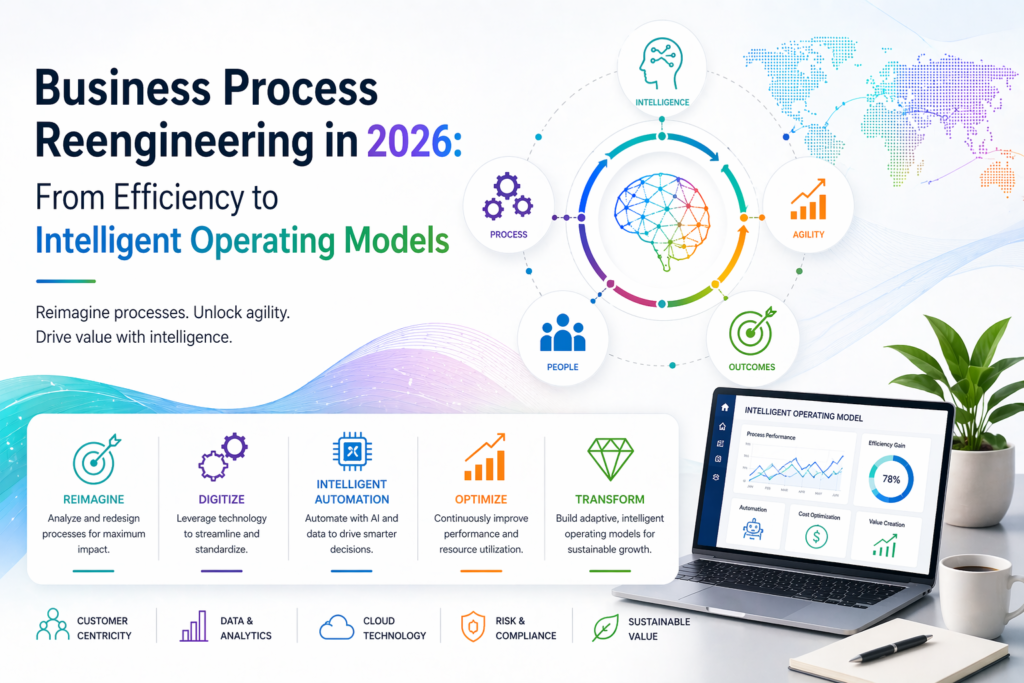
BPR Is No Longer Just About Efficiency For years, Business Process Reengineering (BPR) was about efficiency—faster workflows, reduced costs, and incremental improvements. That era is over. In 2026, BPR is no longer about improving processes. It is about rethinking whether those processes should exist at all. Across industries, AI and process mining expose a hard truth: many workflows were never designed for today’s speed, scale, or complexity. They are layered with approvals, redundancies, and manual dependencies that no longer make sense. The most forward-looking organisations are not optimising these processes.They are eliminating them. The Rise of Zero-Based Process Design This shift toward zero-based process design is redefining BPR. Instead of asking “How do we make this faster?” leaders are asking, “If we built this today, would we design it this way?” In most cases, the answer is no. Technology is accelerating this transformation. Process mining tools now provide real-time visibility into how work actually flows—not how it is documented. AI goes further, identifying inefficiencies, simulating redesign scenarios, and even automating decisions. What was once a one-time transformation initiative is becoming a continuous capability. This enterprise risk management blog also reflects a wider leadership concern: process redesign can no longer be separated from governance, accountability, and risk visibility. Autonomous Workflows Are Changing Process Design Another major shift is the rise of autonomous and agentic workflows. AI systems are no longer limited to rule-based automation. They are now capable of interpreting context, prioritising actions, and executing decisions. This is enabling: In effect, processes are becoming self-correcting systems. Governance Is Now Central to BPR But this introduces a new challenge—governance. When decisions are made by systems rather than people, accountability becomes less visible. Control points can be bypassed. Risks can scale faster than oversight mechanisms. This is why BPR is increasingly converging with governance and risk management. Process design is no longer just an operational concern. It is a control architecture decision. Every redesigned workflow must answer: Without this, efficiency gains can quickly turn into risk exposure. Human-AI Symbiosis Will Shape the Future of Work There is also a human dimension that cannot be ignored. The future of BPR is not full automation—it is human-AI symbiosis. AI excels at scale, speed, and pattern recognition. Humans bring judgment, context, and ethical reasoning. The most effective operating models integrate both — automating routine decisions while reserving critical judgment for human oversight. The organisations that succeed are those that redesign work around this balance. A practical example illustrates the shift. A public sector entity redesigned its procurement process using process mining and AI-driven matching. By eliminating redundant approvals and automating vendor selection, it reduced cycle time from 45 days to under a week—while improving transparency and control. The outcome was not just efficiency. It was better governance through better design. This is the future of BPR. It is not about doing the same work faster.It is about doing fundamentally different work. Organisations that embrace this shift will operate with greater agility, lower cost structures, and stronger control environments. Those that continue to optimise legacy processes will find themselves constrained by complexity. The real question for leadership is no longer: How do we improve processes?It is: What work should exist in the first place? StraitsTribe helps organisations redesign operating models where processes, controls, and AI work together—creating intelligent, scalable, and risk-aware enterprises.