


Sustainability in 2026: From Reporting Obligation to Strategic and Financial Imperative
Sustainability has entered a new phase. For years, ESG was largely driven by reporting frameworks, stakeholder expectations, and corporate positioning. Organisations focused on disclosures, commitments, and narrative. That is no longer enough. In 2026, sustainability is being reshaped by regulation, capital markets, and operational risk. It is moving from a reporting exercise to a core business and financial imperative. The shift is visible globally. Regulatory frameworks such as the EU’s Corporate Sustainability Reporting Directive (CSRD) are setting new standards for transparency, requiring detailed, auditable disclosures across environmental and social dimensions. At the same time, regulators across Asia are aligning with similar expectations, signalling that sustainability must be measurable, verifiable, and integrated into decision-making. This is changing how boards think about ESG. The conversation is no longer about what to disclose.It is about what it means for business performance and risk. One of the most significant developments is the recognition that climate risk is enterprise risk. Extreme weather events, supply chain disruptions, and regulatory changes are already affecting operations and financial outcomes. Scenario analyses show that climate-related risks can materially impact asset valuations, cost structures, and long-term viability. This has pushed organisations to move beyond mitigation toward adaptation and resilience. Companies are now investing in: Sustainability is no longer just about reducing impact.It is about ensuring the organisation can operate under changing conditions. Another major shift is the role of data. Sustainability reporting depends on large volumes of complex data — particularly across value chains. Scope 3 emissions, which often account for the majority of environmental impact, remain difficult to measure accurately. This is where technology is playing a transformative role. AI is enabling: However, it also introduces new risks—data quality issues, model assumptions, and governance gaps. As a result, ESG is increasingly becoming a data governance challenge. Boards must ensure that sustainability data is: Without this, disclosures lose credibility and expose organisations to regulatory and reputational risk. Another emerging trend is the shift from ESG narrative to ROI. Investors are no longer satisfied with commitments. They are looking for measurable outcomes and financial alignment. Sustainability initiatives are being evaluated based on their impact on cost efficiency, revenue opportunities, and risk mitigation. This is transforming ESG into a capital allocation decision. Organisations that integrate sustainability into strategy are better positioned to attract investment, manage risk, and build long-term resilience. Those that treat it as a compliance exercise risk falling behind. There is also increasing fragmentation in global regulation. Different regions are adopting varying approaches to sustainability, creating complexity for multinational organisations. This makes governance even more critical. Boards must navigate multiple regulatory environments while maintaining consistency in strategy and reporting. The organisations that succeed will be those that treat sustainability not as a standalone function, but as an integrated operating principle. Sustainability is no longer about reporting performance.It is about designing organisations that can perform sustainably. StraitsTribe partners with organisations to embed sustainability into governance, risk, and strategy—turning ESG from compliance into a driver of resilience and long-term value.
Business Process Reengineering in 2026: From Efficiency to Intelligent Operating Models
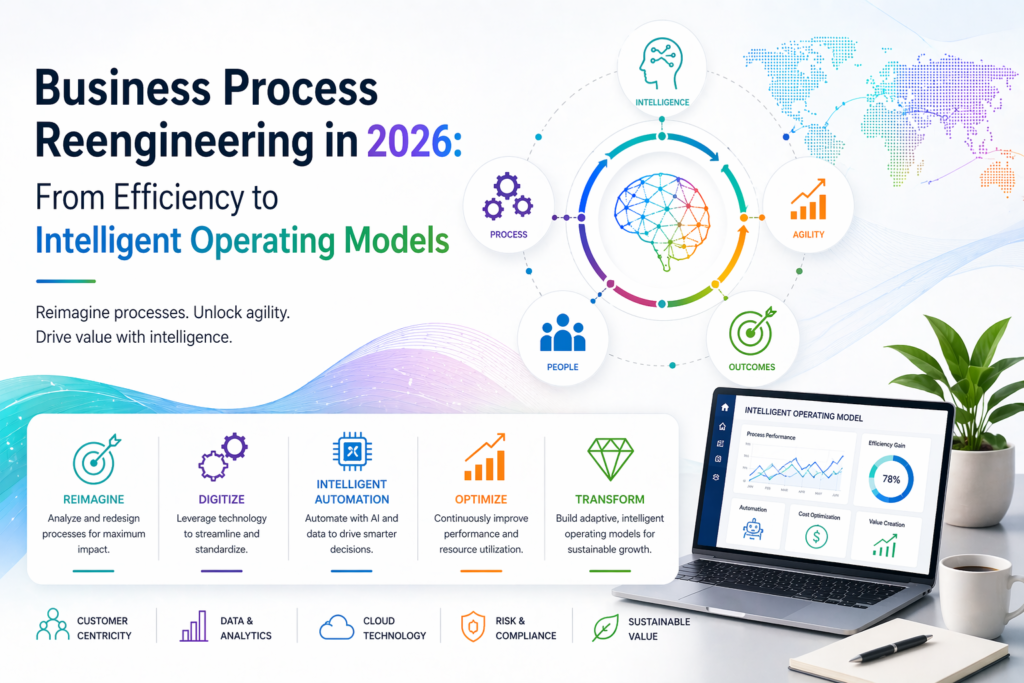
For years, Business Process Reengineering (BPR) was about efficiency—faster workflows, reduced costs, and incremental improvements. That era is over. In 2026, BPR is no longer about improving processes. It is about rethinking whether those processes should exist at all. Across industries, AI and process mining expose a hard truth: many workflows were never designed for today’s speed, scale, or complexity. They are layered with approvals, redundancies, and manual dependencies that no longer make sense. The most forward-looking organisations are not optimising these processes.They are eliminating them. This shift toward zero-based process design is redefining BPR. Instead of asking “How do we make this faster?” leaders are asking, “If we built this today, would we design it this way?” In most cases, the answer is no. Technology is accelerating this transformation. Process mining tools now provide real-time visibility into how work actually flows—not how it is documented. AI goes further, identifying inefficiencies, simulating redesign scenarios, and even automating decisions. What was once a one-time transformation initiative is becoming a continuous capability. Another major shift is the rise of autonomous and agentic workflows. AI systems are no longer limited to rule-based automation. They are now capable of interpreting context, prioritising actions, and executing decisions. This is enabling: In effect, processes are becoming self-correcting systems. But this introduces a new challenge—governance. When decisions are made by systems rather than people, accountability becomes less visible. Control points can be bypassed. Risks can scale faster than oversight mechanisms. This is why BPR is increasingly converging with governance and risk management. Process design is no longer just an operational concern. It is a control architecture decision. Every redesigned workflow must answer: Without this, efficiency gains can quickly turn into risk exposure. There is also a human dimension that cannot be ignored. The future of BPR is not full automation—it is human-AI symbiosis. AI excels at scale, speed, and pattern recognition. Humans bring judgment, context, and ethical reasoning. The most effective operating models integrate both — automating routine decisions while reserving critical judgment for human oversight. The organisations that succeed are those that redesign work around this balance. A practical example illustrates the shift. A public sector entity redesigned its procurement process using process mining and AI-driven matching. By eliminating redundant approvals and automating vendor selection, it reduced cycle time from 45 days to under a week—while improving transparency and control. The outcome was not just efficiency. It was better governance through better design. This is the future of BPR. It is not about doing the same work faster.It is about doing fundamentally different work. Organisations that embrace this shift will operate with greater agility, lower cost structures, and stronger control environments. Those that continue to optimise legacy processes will find themselves constrained by complexity. The real question for leadership is no longer: How do we improve processes?It is: What work should exist in the first place? StraitsTribe helps organisations redesign operating models where processes, controls, and AI work together—creating intelligent, scalable, and risk-aware enterprises.
Southeast Asia’s Next GRC Frontier: Governing the Digital Economy at Speed
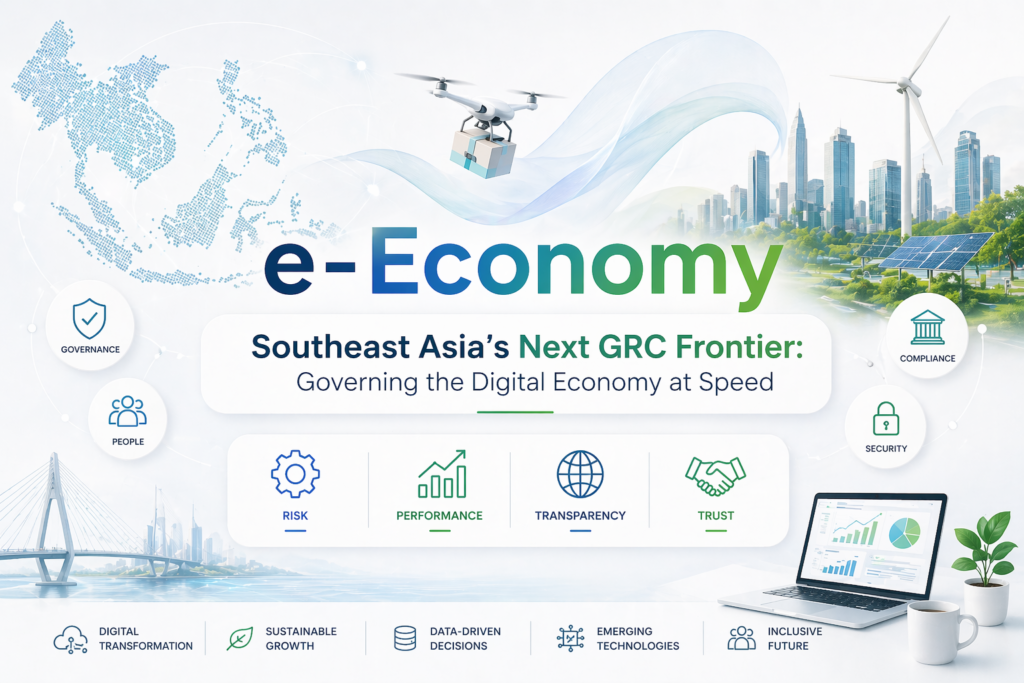
Southeast Asia is no longer a fast follower in governance. It is becoming a testing ground for how regulation keeps pace with digital growth. Across Singapore, Indonesia, Malaysia, Vietnam, and Thailand, digital economies are scaling rapidly—driven by e-commerce, fintech, platform ecosystems, and cross-border data flows. With that growth comes a new kind of risk: speed without visibility. Regulators across the region are responding decisively. In Singapore, the Monetary Authority of Singapore (MAS) continues to sharpen expectations on technology risk and operational resilience. Bank Negara Malaysia is strengthening oversight on digital financial services and third-party risk. Indonesia’s OJK is tightening governance requirements across financial institutions, particularly around data and consumer protection. The signal is clear: growth is welcome—but not at the cost of control. What makes Southeast Asia unique is the convergence of three forces. First, digital adoption is accelerating faster than governance maturity. Organisations are deploying AI, cloud platforms, and digital ecosystems at scale. But oversight mechanisms—controls, monitoring, accountability—are still catching up. This creates blind spots where risk can accumulate unnoticed. Second, regulation is becoming more outcome-driven. Regulators are no longer satisfied with policies and frameworks. They are asking: Do your controls actually work in real time? Can you demonstrate it? This is pushing organisations toward continuous monitoring, stronger data governance, and auditable decision-making. Third, accountability is moving upward. Recent enforcement actions across the region show a clear trend—boards and senior management are increasingly in scope. Governance is no longer something that can be delegated downward. A practical example illustrates this shift. A regional financial institution faced regulatory scrutiny not because controls were absent, but because they were not operating effectively in practice. The issue was not design—it was execution visibility. This is becoming a common theme. In response, leading organisations are evolving their GRC models in three ways: There is also a growing recognition that data is now at the centre of governance. Whether it is customer data, transaction data, or ESG data, the ability to manage, validate, and monitor data flows is becoming a critical control point. For Southeast Asia, this presents both a challenge and an opportunity. The challenge is complexity—multiple jurisdictions, evolving regulations, and diverse operating environments. The opportunity is leadership. Organisations that build adaptive, technology-enabled governance models can move faster, scale more confidently, and earn greater trust from regulators and investors. The question boards should be asking is no longer: Are we compliant?It is: Can we demonstrate control in a real-time, digital environment? Because in Southeast Asia’s digital economy, governance is no longer a back-office function.It is a strategic enabler of growth. StraitsTribe works with organisations across Southeast Asia to design adaptive GRC frameworks that keep pace with digital transformation—turning governance into a driver of trust, resilience, and scalable growth.
Integrated Risk Architecture: The End of Siloed Risk Management
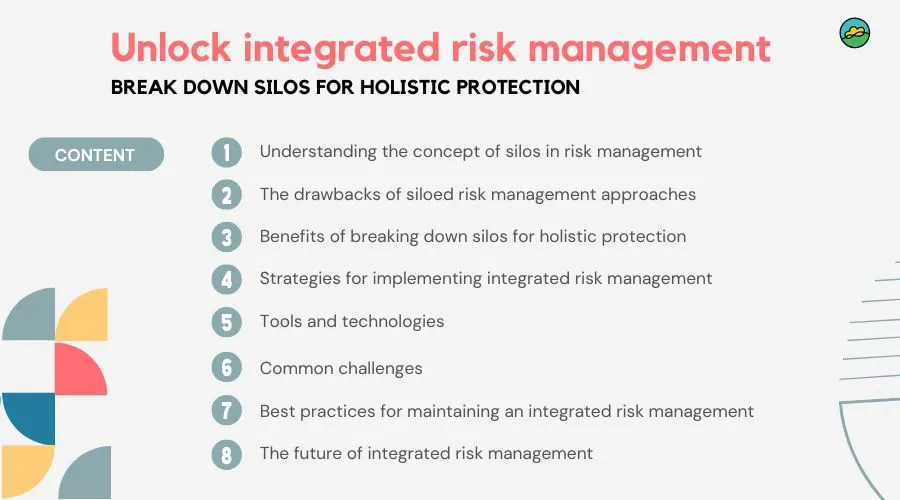
Most organisations manage risk in silos. Cyber teams monitor cyber threats. Finance tracks financial risk. Operations manage supply chain disruptions. But real-world risks do not occur in silos. A cyber incident can trigger operational disruption, regulatory action, and financial loss simultaneously. Without integration, organisations fail to see the full picture. A financial institution I worked with integrated 17 separate risk systems into a unified platform. The result was a 40% improvement in risk visibility and faster decision-making at the board level. This is the essence of integrated risk architecture. It requires: The goal is not more data — it is better insight. Integrated systems allow organisations to understand how risks interact, amplify, and cascade. Regulators are increasingly expecting this level of integration, particularly in areas such as operational resilience and systemic risk. Boards must move from reviewing individual risk reports to understanding aggregate exposure. The key question is: What happens when multiple risks occur together? Organisations that adopt integrated risk architecture gain a strategic advantage. They can anticipate, respond, and adapt more effectively. Those that remain siloed risk being surprised by interconnected failures. In a complex and volatile environment, visibility is everything. CTA: StraitsTribe designs integrated risk architectures that provide boards with a unified, real-time view of enterprise risk.
Climate Risk Is Now a Financial and Strategic Reality

Climate risk is no longer a future concern. It is a present financial reality. Regulatory frameworks such as TCFD and ISSB are pushing organisations to quantify climate exposure and integrate it into decision-making. Scenario analysis is becoming a standard tool. A commercial real estate portfolio analysis showed valuation declines of up to 30% under high-risk climate scenarios, driven by both physical risks (flooding, heat) and transition risks (policy changes, carbon costs). This has significant implications for boards. Climate risk must now be: The concept of Climate Value at Risk (Climate VaR) is gaining traction as a way to measure potential financial impact under different scenarios. Organisations that fail to integrate climate risk into strategy risk mispricing assets, underestimating exposure, and facing regulatory scrutiny. At the same time, climate transition presents opportunities — in renewable energy, sustainable infrastructure, and green financing. The key is governance. Boards must ensure that climate risk is not treated as a standalone ESG issue, but as part of enterprise risk management. The question is no longer: Are we reporting climate risk?It is: Are we making decisions based on it? Organisations that take a proactive approach will be better positioned to navigate both risk and opportunity. CTA: StraitsTribe helps organisations integrate climate risk into financial strategy and governance frameworks.
Third-Party Risk Is Expanding Faster Than Governance Can Keep Up
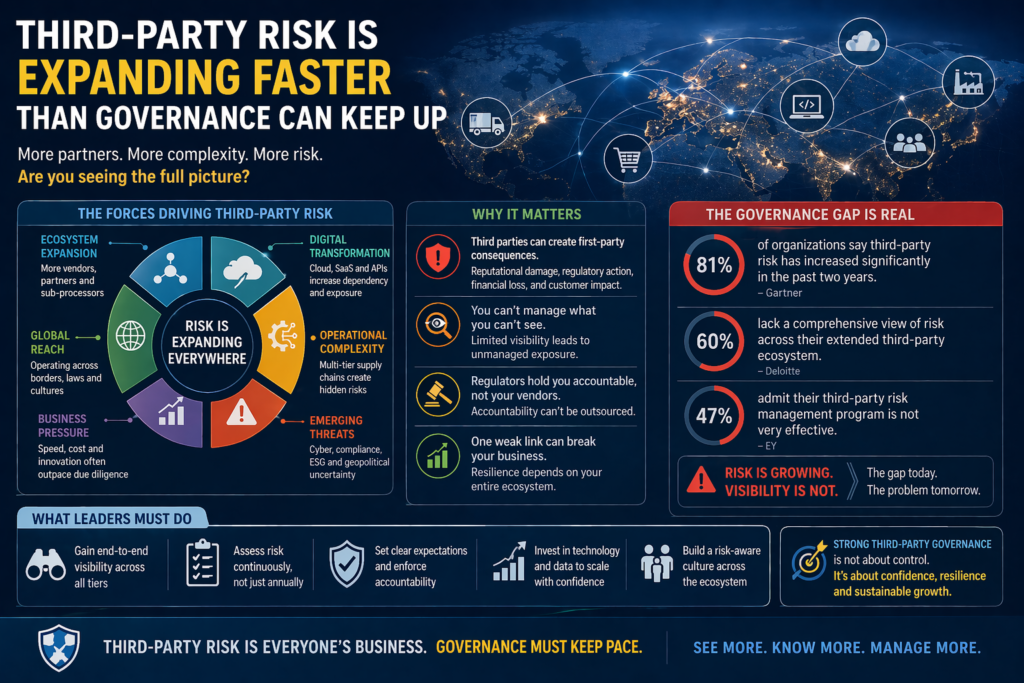
Modern organisations operate within vast ecosystems of vendors, partners, and service providers. In many cases, these third parties outnumber internal employees. This creates a significant challenge: risk is no longer contained within the organisation. Studies indicate that over 70% of cyber incidents involve third parties, yet governance frameworks often remain fragmented and reactive. A regional bank transitioned from spreadsheet-based vendor tracking to an automated third-party risk management platform. The results were immediate: This highlights the importance of moving toward structured, technology-enabled TPRM. Effective third-party risk management includes: Another common gap is over-reliance on self-assessment questionnaires. These provide limited assurance and can create a false sense of security. Leading organisations supplement this with: Boards must also recognise that third-party risk is dynamic. Vendors change, environments evolve, and new risks emerge. The focus must shift from periodic reviews to continuous oversight. The key question is: Do we understand the risk our ecosystem introduces? Organisations that manage this well gain not just protection, but operational efficiency and stronger partnerships. Those that don’t risk exposure beyond their direct control. CTA: StraitsTribe helps organisations build scalable, enterprise-wide third-party risk management frameworks.
Culture Risk: The Most Overlooked Risk in the Boardroom
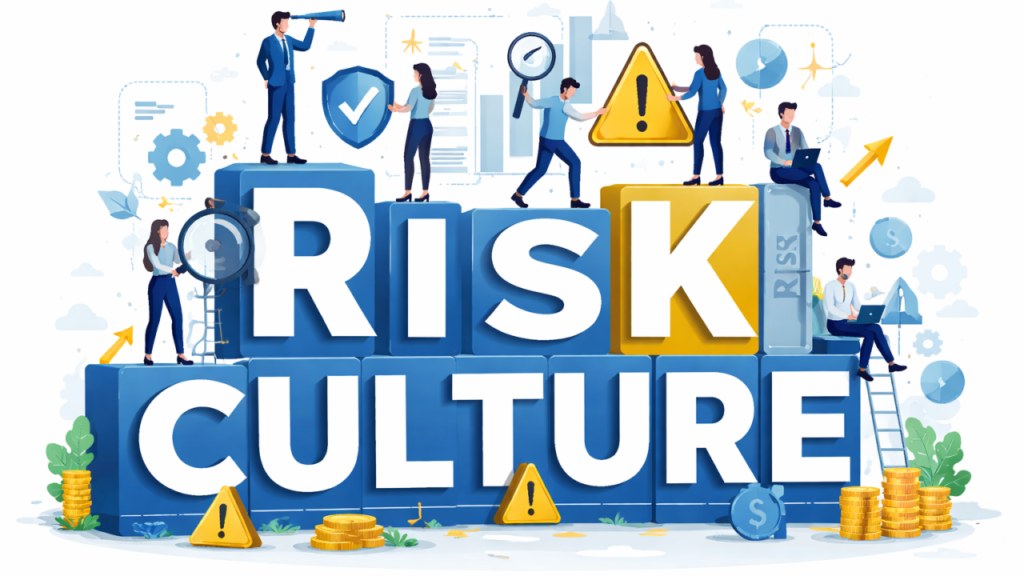
Culture is often described as intangible. But its impact is anything but. Recent global enforcement cases — particularly in financial services — have shown that cultural failures can lead to billions in fines, reputational damage, and leadership exits. Regulators are taking note. Across Asia, expectations are rising for boards to demonstrate oversight of organisational culture, not just financial and operational performance. The challenge is measurement. Traditional approaches rely on annual employee surveys. These provide a snapshot, not a signal. Leading organisations are moving toward continuous culture monitoring, using multiple data sources: A financial institution I worked with identified early warning signs through declining employee sentiment and increased complaints related to sales pressure. By intervening early — adjusting incentives and reinforcing ethical practices — the organisation reduced complaints by 40% and improved engagement scores significantly. This demonstrates that culture risk is measurable — if approached correctly. Effective culture governance requires: Boards must also shift their perspective. Culture is not an HR issue. It is a risk driver that influences decision-making across the organisation. The key question boards should ask is not: Do we have the right culture?It is: What behaviours are we actually incentivising? Culture shapes how decisions are made when no one is watching. Organisations that actively measure and manage culture risk are better equipped to prevent misconduct, enhance performance, and build long-term trust. Those that ignore it often discover its impact only after failure. CTA: StraitsTribe helps boards build measurable culture risk frameworks that translate behaviour into actionable governance insights.
GRC Is No Longer a Function. It Is Becoming the Operating System
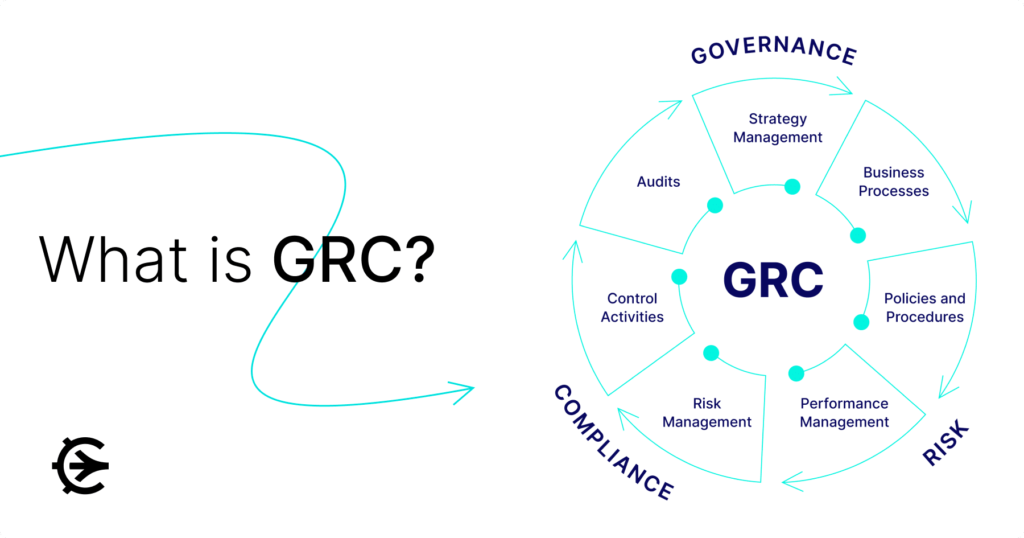
For years, Governance, Risk, and Compliance sat quietly in the background of organizations — structured, methodical, and largely retrospective. It was built around control, periodic audits, static risk registers, and compliance checklists that operated on a predictable rhythm. But that world no longer exists. Today, risk moves faster than governance frameworks were ever designed to handle. Artificial intelligence is accelerating decisions, regulations are evolving in real time, and ESG scrutiny is reshaping expectations from regulators, investors, and stakeholders alike. In this environment, GRC can no longer remain a support function. It is increasingly becoming the operating system of the enterprise. What we are witnessing is a fundamental shift from oversight to intelligence. Leading organizations are moving away from episodic reviews toward continuous, data-driven governance. This is not just a technology upgrade; it is a change in how organizations think about risk. AI systems are now making autonomous decisions, supply chains are globally interconnected, cyber threats evolve by the hour, and ESG disclosures are under constant scrutiny. Nearly half of organizations are already using AI for real-time risk monitoring, while a significant proportion are automating compliance workflows. This signals a clear direction of travel — toward governance that is always on, always informed, and always relevant. At the same time, a critical gap is emerging. While AI adoption is accelerating rapidly, governance is struggling to keep pace. Many boards still lack formal oversight mechanisms for AI, even as organizations scale intelligent systems across operations. This creates a paradox where innovation is moving at speed, but accountability is lagging behind. Without the right governance structures, AI does not just create opportunity — it introduces new forms of risk, from bias and opacity to regulatory exposure and reputational damage. This is where GRC must evolve beyond control and become a strategic enabler of responsible innovation. One of the most persistent challenges I continue to see is fragmentation. Risk sits in one system, compliance in another, audit in a third, and ESG somewhere else entirely. This siloed approach creates blind spots, and in today’s environment, blind spots are not just inefficiencies — they are vulnerabilities. Modern GRC is moving toward integrated ecosystems where data flows across functions, enabling real-time visibility and shared accountability. Because risk does not exist in silos, governance cannot afford to either. What differentiates organizations that are getting this right is not the number of frameworks they have in place, but the quality of questions their leadership teams are asking. Do we have real-time visibility of risk? Is AI being governed as rigorously as it is being deployed? Are decisions being made with integrated risk intelligence? GRC is shifting from assurance to advisory, from checking compliance to shaping strategy. It is no longer about documenting what went wrong, but about anticipating what could. We are entering an era where governance must move at the speed of business. In a world of real-time risk, delayed governance is not just ineffective — it is a failure. The organizations that will lead are those that recognize GRC not as a function to manage, but as a capability to compete. Because increasingly, the difference between resilience and disruption lies in how intelligently and how quickly an organization can govern itself.
Supply Chain Risk Is No Longer Operational — It’s Strategic
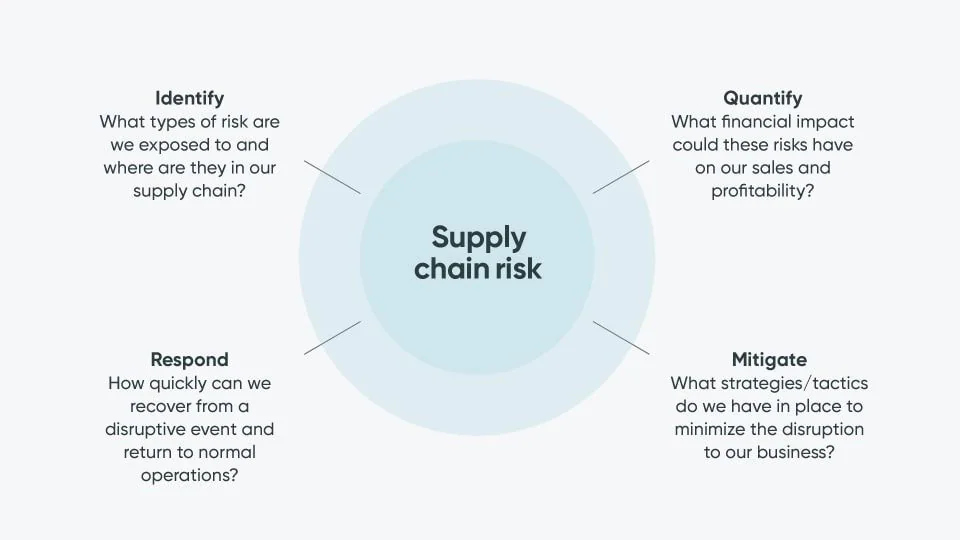
Supply chains used to be managed by procurement teams. Today, they are shaped by geopolitics, climate events, and systemic dependencies. This shift has elevated supply chain risk to the boardroom. Global disruptions now cost the economy an estimated $1.7 trillion annually. For trade-dependent economies like Singapore, the impact is even more pronounced. The challenge is no longer visibility at Tier 1 suppliers. It is understanding interconnected risk across entire ecosystems. A recent disruption in semiconductor production in Malaysia had cascading effects on industries across Southeast Asia, including financial services infrastructure. This illustrates how supply chain risk is no longer linear — it is networked. Traditional risk management approaches are no longer sufficient. Leading organisations are moving toward resilience engineering, which focuses on the ability to absorb and recover from disruption. Key strategies include: A manufacturing firm I advised shifted from a single-source supplier model to a dual-source strategy across different countries. While costs increased slightly, supply availability improved to over 95% reliability, significantly reducing operational risk. Technology is also playing a critical role. AI-driven demand forecasting, IoT-based tracking, and blockchain for traceability are enabling better visibility and responsiveness. But resilience is not just a technical issue — it is a governance issue. Boards must: The key question is no longer: Are we efficient?It is: Are we resilient under stress? Organisations that invest in resilience will be better positioned to navigate volatility. Those that optimise only for cost will remain vulnerable. CTA: StraitsTribe helps organisations design resilient, risk-aware supply chains aligned with strategic and governance priorities.
Business Process Reengineering in the AI Era: Stop Automating the Wrong Work
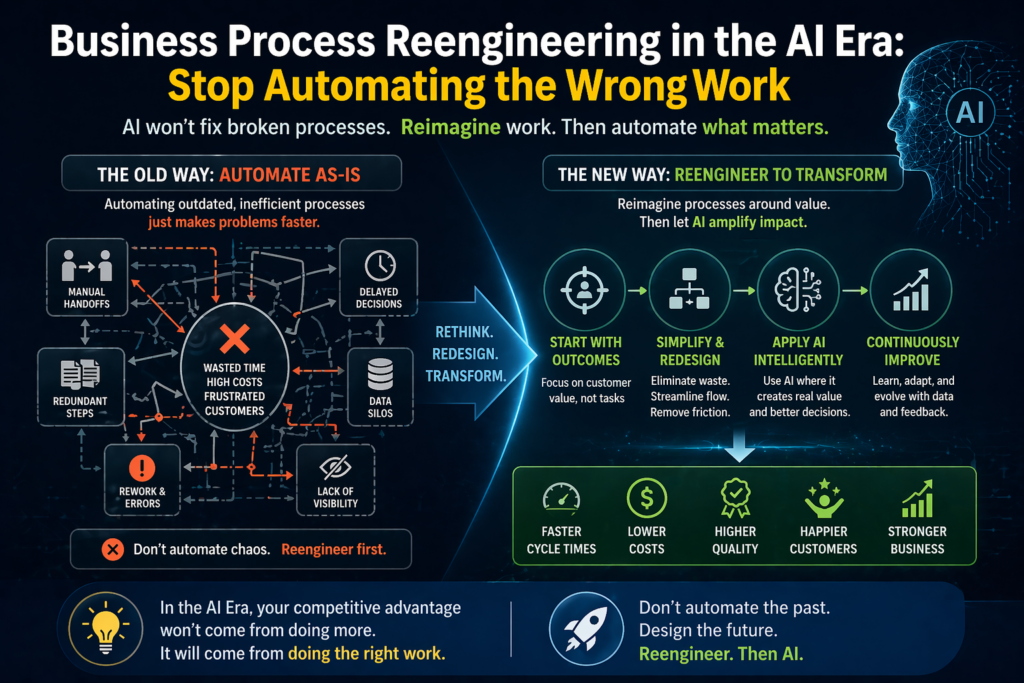
There is a pattern I see repeatedly: organisations rush to automate processes using AI — without questioning whether those processes should exist at all. This is where Business Process Reengineering (BPR) becomes critical again. The original principle of BPR was simple: don’t automate inefficiency — eliminate it. Yet in the current AI wave, many organisations are digitising legacy workflows instead of redesigning them. The result? Faster inefficiency. Technologies like process mining and AI now provide unprecedented visibility into how work actually happens. Studies show that organisations applying these tools effectively can achieve 60–80% reduction in cycle times. But the real value comes from asking a more fundamental question:If we were designing this process today, would it look the same? In most cases, the answer is no. A government agency I worked with reduced its procurement cycle from 45 days to 5 days. This was not achieved through automation alone. It required eliminating redundant approvals, redesigning workflows, and using AI for vendor matching and decision support. This is what modern BPR looks like. It is built on three principles: Another critical aspect is governance. Rapid process redesign without proper controls can introduce new risks. Organisations must ensure: The biggest barrier to BPR today is not technology — it is mindset. Middle management often resists change because existing processes reflect established roles and authority structures. Successful transformation requires leadership to challenge these assumptions and create space for reinvention. The organisations that succeed are not those that automate the fastest. They are the ones willing to rethink how work is structured. AI amplifies capability — but only when applied to the right processes. In a world of increasing complexity, the goal is not to do more work faster.It is to do less work, better. CTA: StraitsTribe supports organisations in redesigning processes for AI-enabled operating models that drive efficiency, control, and scalability.